If Santa Had a Superyacht: A Very Real Design Challenge
The call came in March, from a +358 number. Finland. Lapland, to be precise. On the other end of the line, a warm, deep voice: “This is Santa Claus, and I need your help.”
We paused. For a moment, we thought it might be a prank. Then he added: “My current operational base at the North Pole is 1,750 years old. It’s time for an upgrade. A floating one.”
The brief was certainly unusual, but crystal clear: to design and build the interiors of his brand-new luxury icebreaking superyacht —a mobile operational base for the journey of December 24th. It had to navigate through Arctic ice, withstand polar storms, house a fully operational workshop and—most importantly—serve as a launch platform for the reindeer-drawn sleigh.
“I need something that can handle frost, saltwater… and reindeer,” he said, smiling through the phone.
We smiled too. Then we opened CAD software and spreadsheets—and started designing for real.
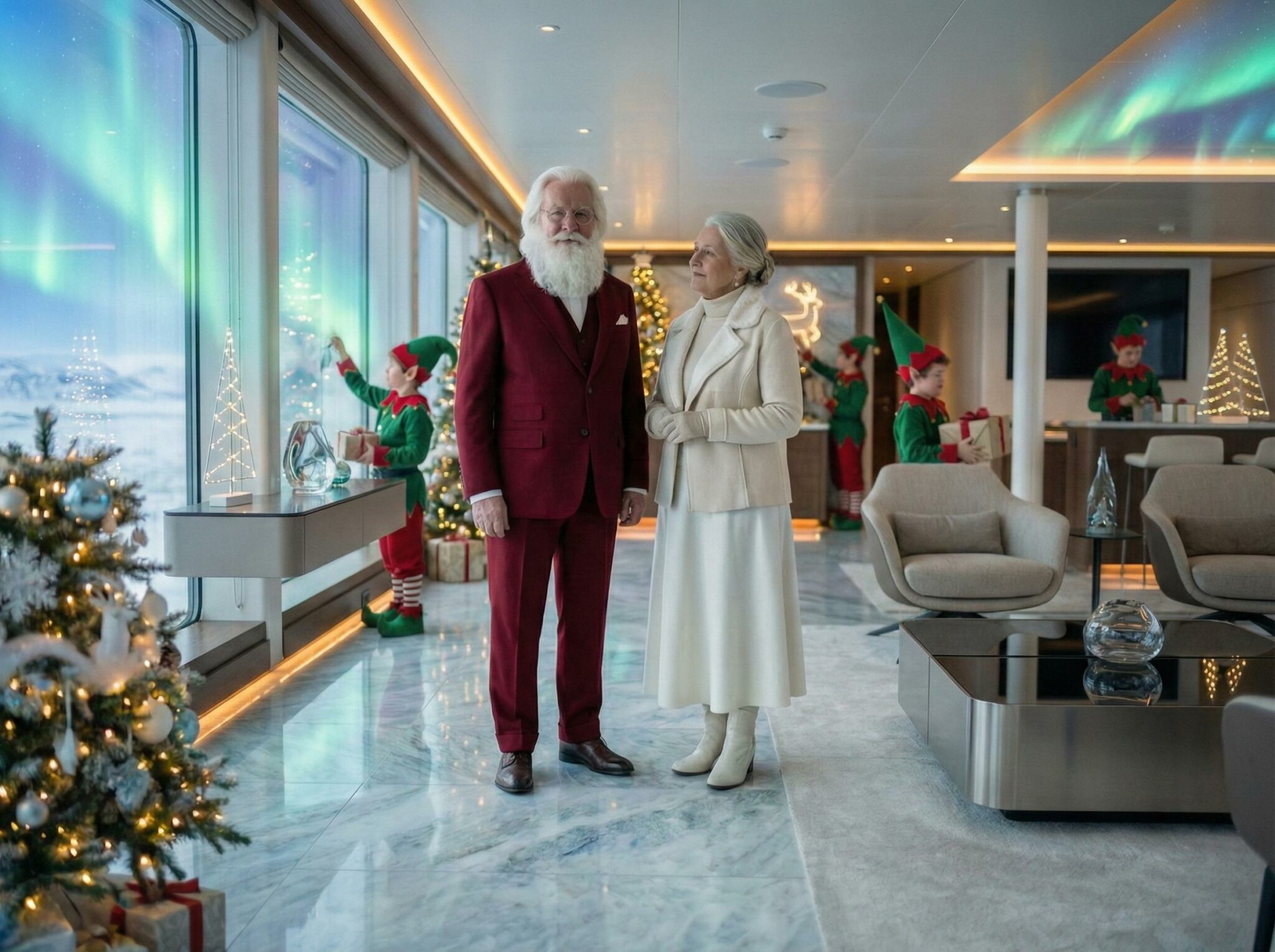
“I want everything to be marble,” Santa said during our first video call, with shelves full of children’s letters visible behind him. “But I absolutely can’t add weight to the yacht. There’s already enough load with all those gifts.”
When we explained that marble can be reduced by up to 70% of its original weight—while preserving its beauty and even improving its performance—his eyes lit up like a child’s on Christmas morning. “So… we can clad everything?”
Yes. Everything. Walls, cabins, corridors—even the sleigh access area, where the reindeer stop briefly before taking off again.
The solution is a technology we have been using in the marine sector for years: lightweight marble with a honeycomb structure, inspired by aerospace engineering.
For Aurora Borealis—the name Santa chose for his yacht, in tribute to his lifelong companion, the northern lights—we clad over 800 square metres of surfaces with a weight equivalent to just 250 square metres of traditional stone. The result impressed even the Arctic shipyard.
“This is when technology starts to feel like magic,” our project manager commented. “The kind of magic Santa appreciates too.”
As Light as Santa’s Sleigh: Lightweight Marble
Hot Ice: Walking Barefoot on the Arctic
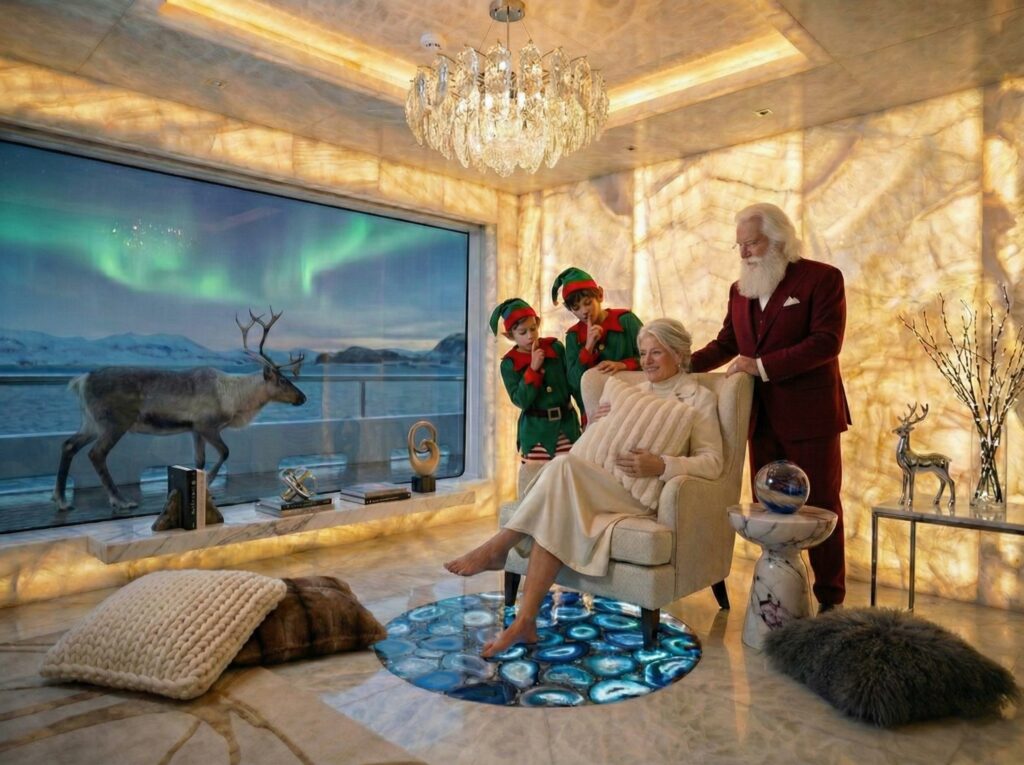
Mrs. Claus’s brief was clear, and seemingly impossible: “I want to walk barefoot on Arctic ice, but with warm feet. I want to see the cold of our home at the North Pole, while enjoying all the comfort of contemporary luxury. Is that too much to ask?”
No, it wasn’t. But it did require creativity.
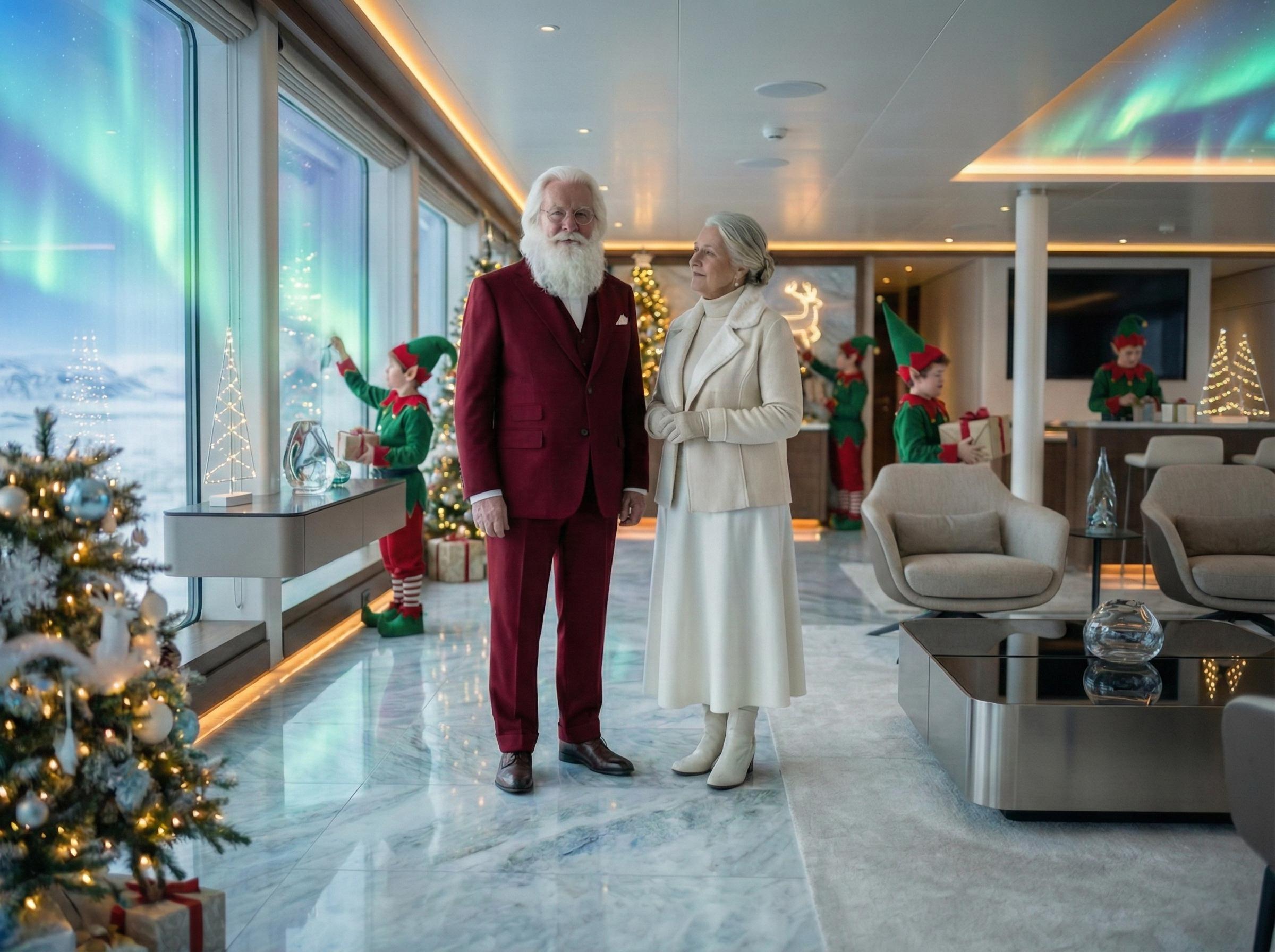
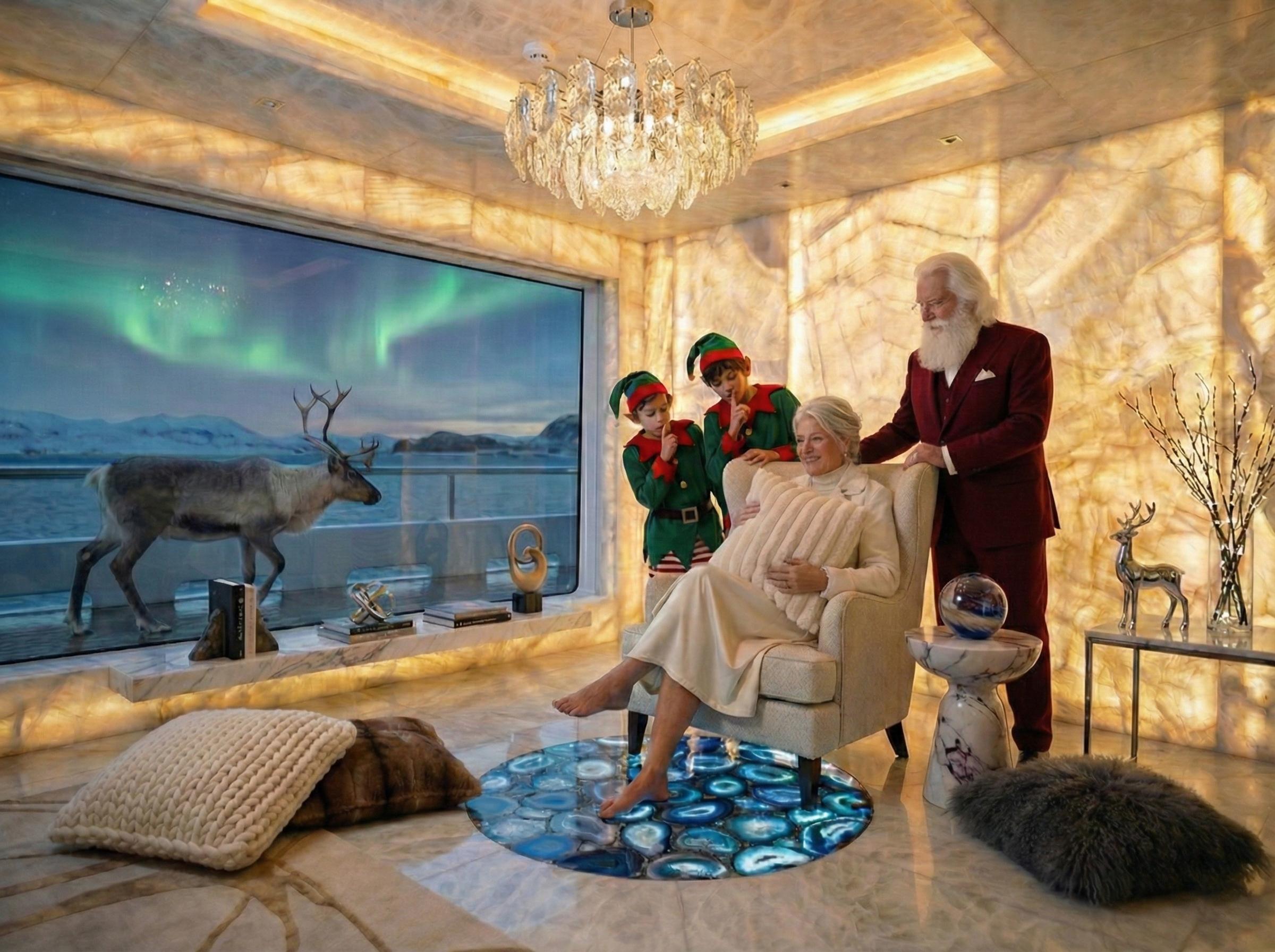
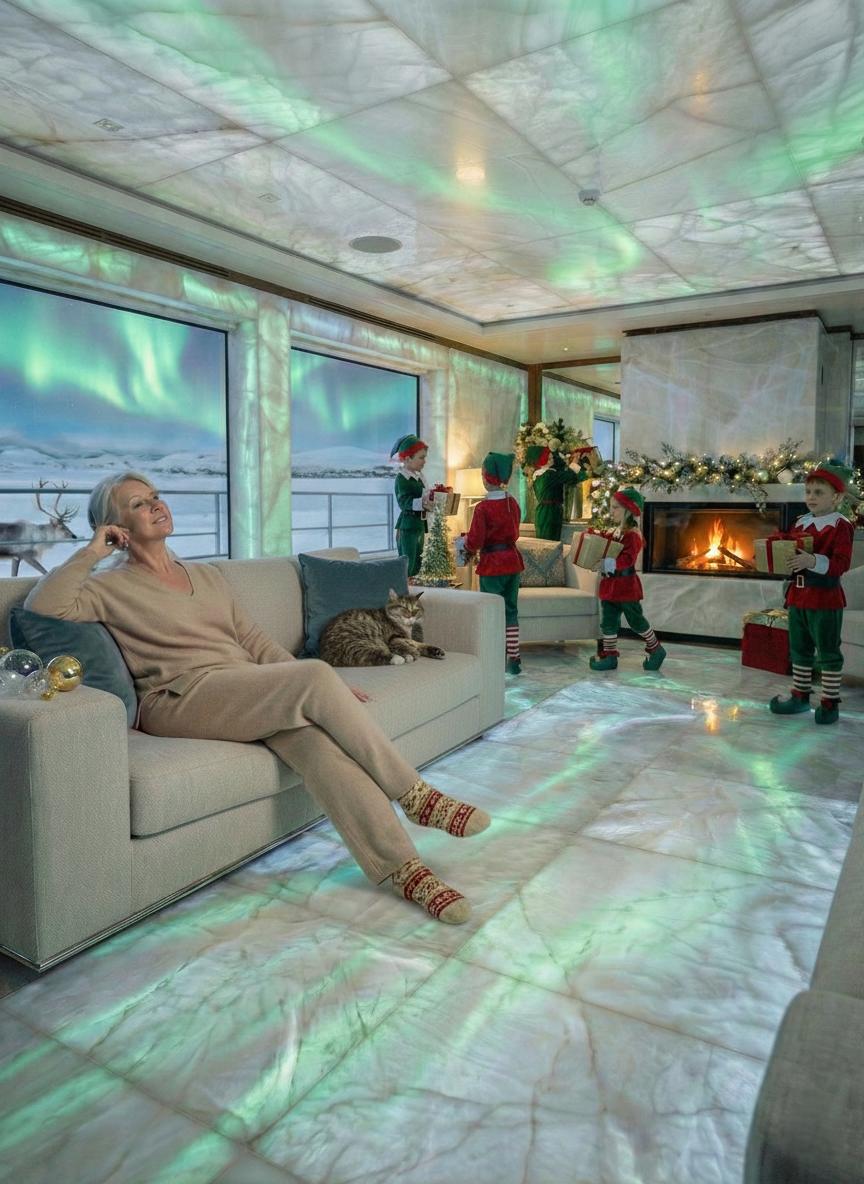
For the walls and floors of the main deck—the space where Santa and Mrs. Claus welcome their guests (yes, Santa has guests; world leaders stop by more often than you might think)—we selected Onice Cristallo from the Margraf collection, a material that perfectly captures the texture of ancient glaciers. Its veining recalls the fractures of polar ice. It looks as if it were cut directly from an iceberg—cool, crystalline, almost translucent.
Beneath the surface, a radiant heating system keeps the temperature at a constant 28°C. Precisely the temperature that makes walking barefoot genuinely comfortable.
The effect is wonderfully disorienting: your eyes say “Arctic chill,” while your feet feel “gentle warmth.”.
For selected details, we used semi-precious stones from Margraf’s exclusive collection—materials so rare that some blocks are genuinely one of a kind. In the spot where Mrs. Claus likes to sit and read, we created a circular inlay in blue agate. A natural “rug” so precious it feels like a jewel set into the floor. The elves call it “the reading spot,” and everyone knows that when Mrs. Claus is there, it’s best not to disturb her.
But the real magic happens when evening falls. Beneath the onyx slabs—integrated with the heating system—we installed programmable LEDs that recreate the aurora borealis. Not generic colored lighting, but a scientifically accurate simulation of those luminous curtains that dance across the Arctic sky.
When the system activates, waves of emerald green blend with flashes of electric blue. The first time we switched it on—during final testing—Mrs. Claus fell silent for a full minute. Then she said:
«As magical as real magic. Maybe even more.»
A Dining Room Carved From Arctic Stone
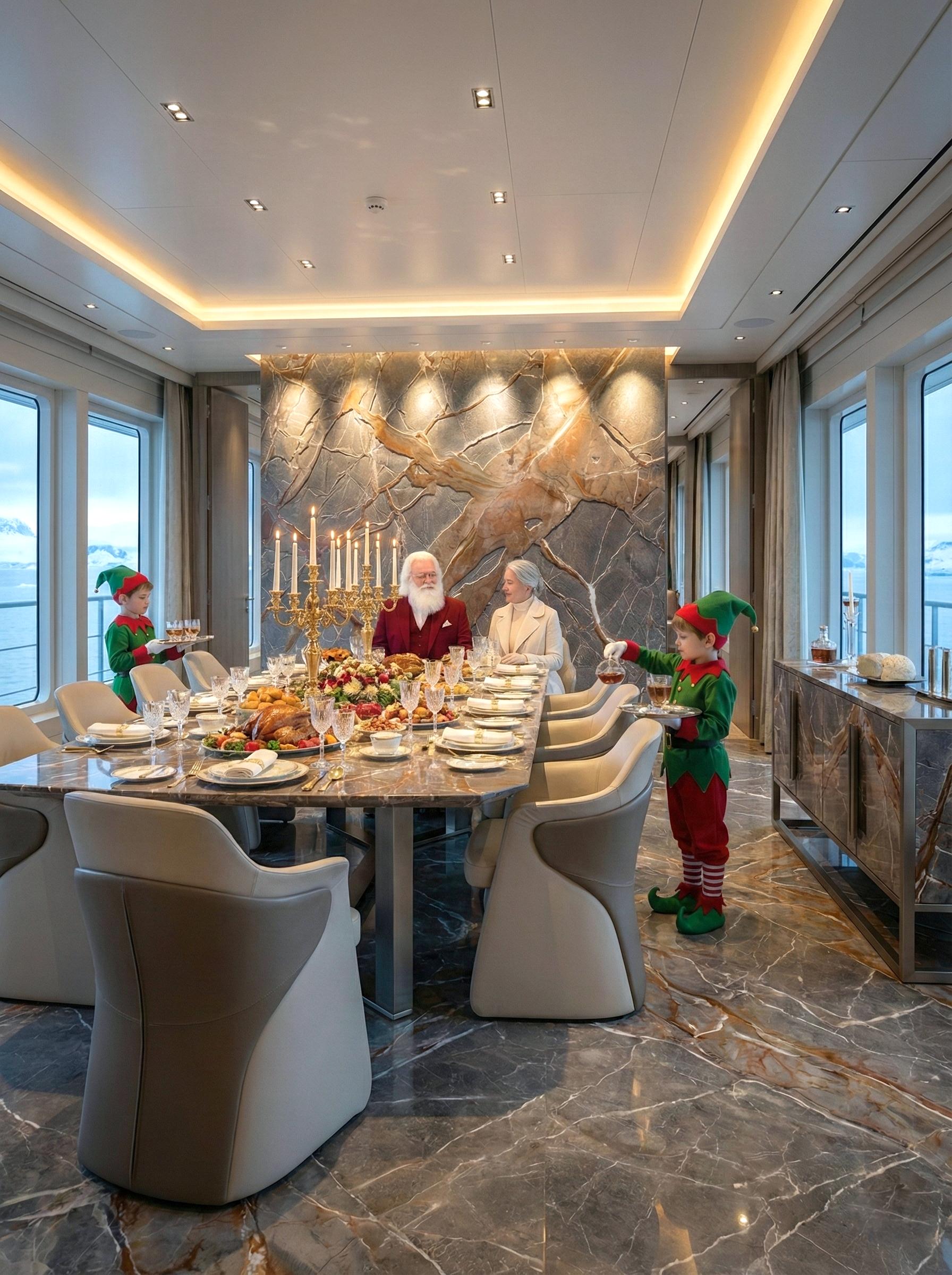
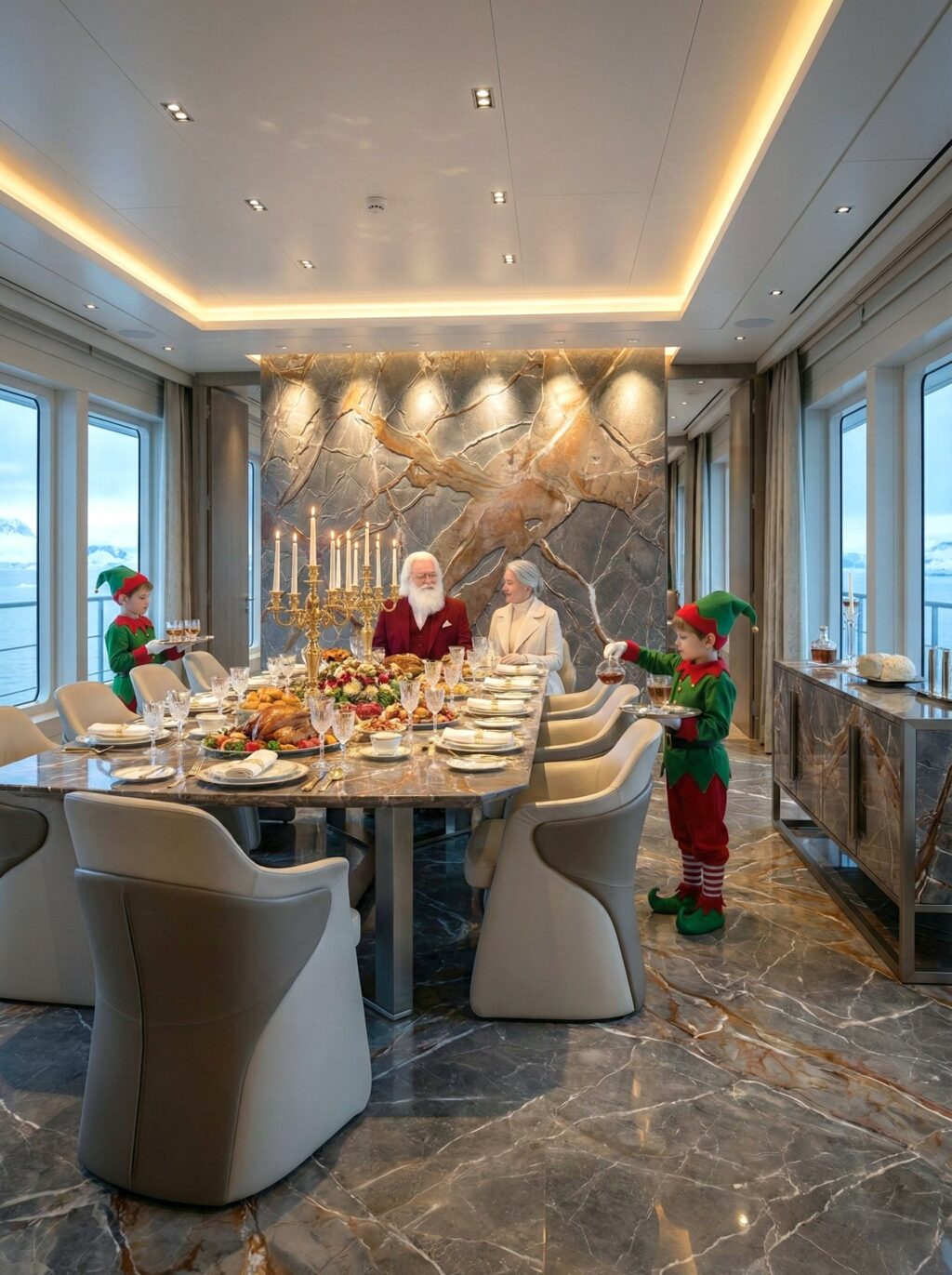
For the dining room, Mrs. Claus had a very precise vision—and, as we quickly learned, one that was not open to negotiation: “I want to feel the presence of the mountain, ancient rock, but refined. Elegant, yet primal.”
Our answer was Ipogeo, an exclusive finish that transforms marble into a surface where every vein becomes a defining feature.
In the dining room of Aurora Borealis, we created a monumental wall measuring 8 by 3 metres, anchoring the entire space. The veining doesn’t lie flat on the surface; it appears carved into millennia-old rock. Light catches on the micro-incisions, creating deep chiaroscuro effects that shift throughout the day. In the evening, with artificial lighting calibrated by a renowned Norwegian lighting designer, the wall reveals new layers of depth—like a rocky landscape gradually unfolding.
In this project, Ipogeo was truly a bespoke finish: the depth, intensity and direction of the incisions were all tailored to Mrs. Claus’s vision.
It isn’t an Ipogeo wall. It’s their Ipogeo wall.
The Reindeer Hangar: Designing for the Unpredictable
Let’s be clear from the start: this was the most complex part of the entire project.
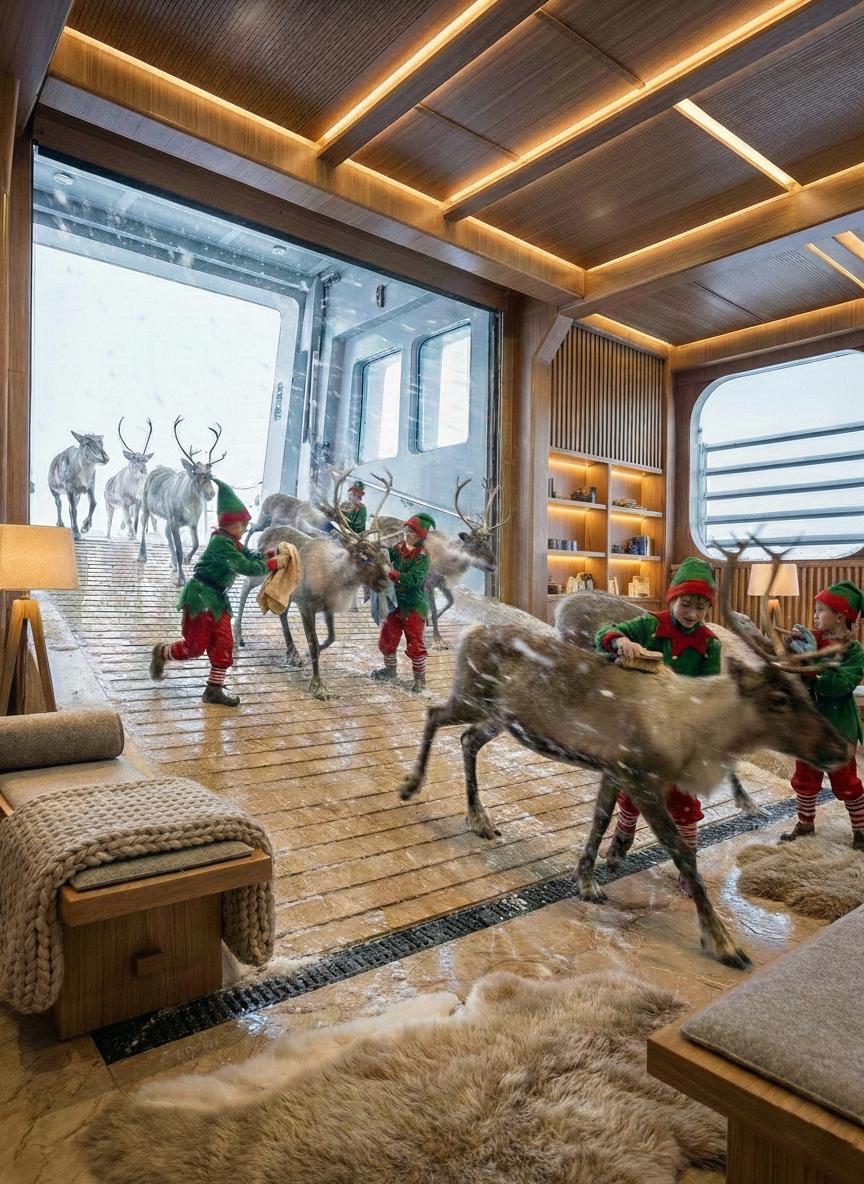
Eight reindeer, plus Rudolph. Thirty-six hooves in total. Coming and going multiple times a day, all year round. And, at the client’s request, marble had to be the absolute protagonist. No protective mats. No aesthetic compromises like “let’s add some rubber so it doesn’t get damaged.” Marble—only marble. Beautiful, and durable.
“The reindeer are part of the family,” Santa explained. “I can’t put them in an ugly space. But let’s be honest—they’re still reindeer. With hooves. They run, they jump, and occasionally slip when they land after a particularly acrobatic flight.”
Challenge accepted.
We developed a three-zone, multi-material strategy, assigning each area the material best suited to the type of stress it would need to withstand.
Zone 1 – The Landing Ramp: When Santa Fiora Meets Santa Claus
This was where the biggest challenge lay: a sloped ramp where the reindeer land, often with hooves still covered in snow or ice. Essentially, a small airport—for reindeer. We needed a surface that was absolutely non-slip, resistant to repeated impact, easy to clean, yet still worthy of a superyacht aesthetic.
The solution? Santa Fiora from Margraf’s exclusive collection. When Santa read the name in the project documents, he stopped. There was a three-second pause (which felt eternal to us), then he smiled. “Santa Fiora? For Santa Claus? If that’s not a sign of fate…”
The name coincidence was amusing, of course, but the choice was technically rock solid. Exceptional resistance to weathering, a naturally grip-friendly texture, and an austere beauty perfectly suited to the Arctic mood.
But that wasn’t enough. We also applied certified anti-slip treatments, customized specifically for Santa Fiora. “Every material reacts differently to treatments,” explains our technical manager. “We tested it with a trial reindeer: 100 landings with wet hooves, icy hooves, dry hooves, and hooves covered in snow. Zero slips.”
Zone 2 – Circulation Paths Must Follow the Rhythm of the Reindeer
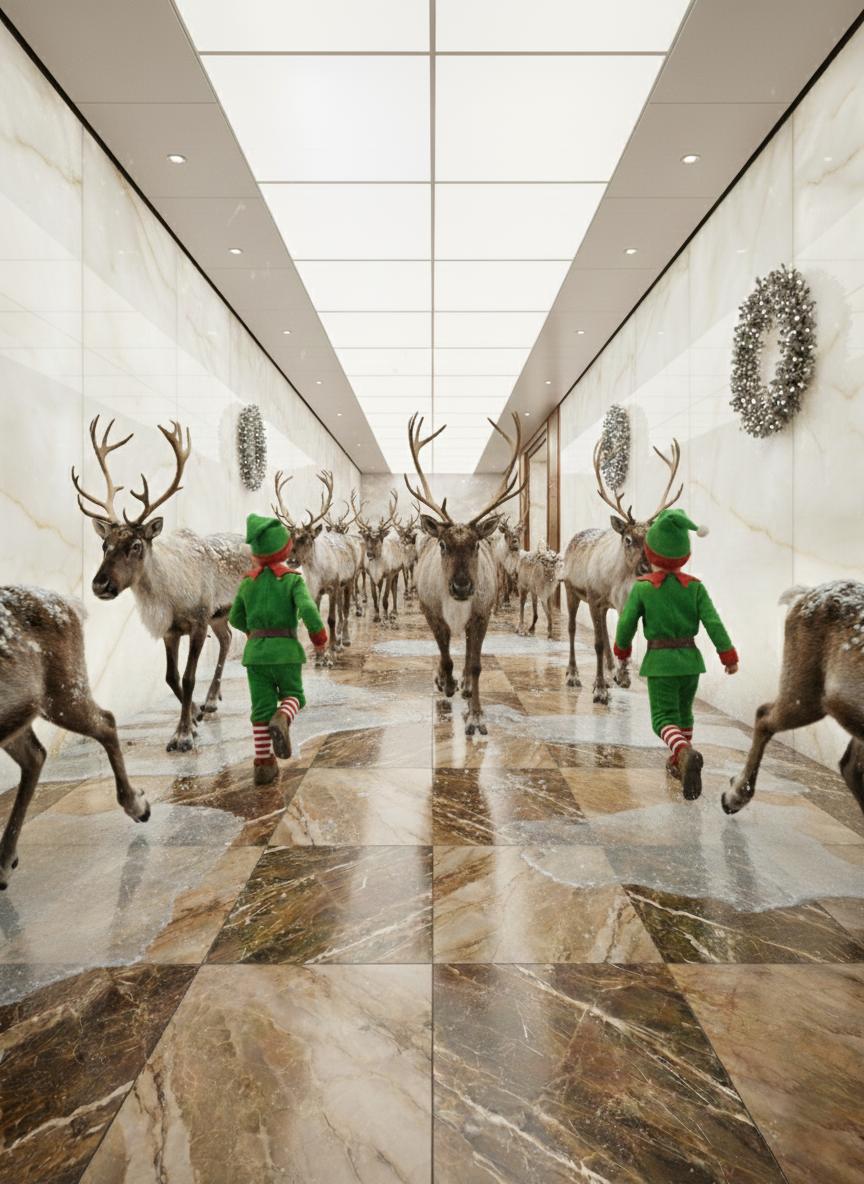
Between landings and take-offs, the reindeer move through these corridors dozens of times a day to reach their resting area, the feeding hall (yes, they have a canteen, stocked with special hay imported from Norway), and the veterinary check-up stations. Heavy traffic, but less dramatic than on the landing ramp.
To support this flow, we selected a high-performance technical material, engineered to withstand heavy traffic, moisture and temperature fluctuations, while maintaining a naturally non-slip surface even under the most demanding conditions. The finish is structured just enough to ensure safety, yet controlled enough to remain elegant and fully aligned with the yacht’s overall design language.
It’s a solution that doesn’t aim to impress, but to perform consistently—allowing the reindeer to move with confidence, as if they were walking on terrain they’ve known all their lives.
Zone 3 – The Resting Area, Where Scratches Become Character
Where the reindeer actually rest, we needed something that felt visually warm, comfortable, and capable of ageing gracefully.
We chose a brushed leather finish on a marble with an already naturally dynamic texture. The inevitable micro-scratches blend into that texture, becoming part of the aesthetic rather than flaws.
Design becomes poetry when materials carry the memory of time.
The Elves’ Workshop: Where Gifts Are Born
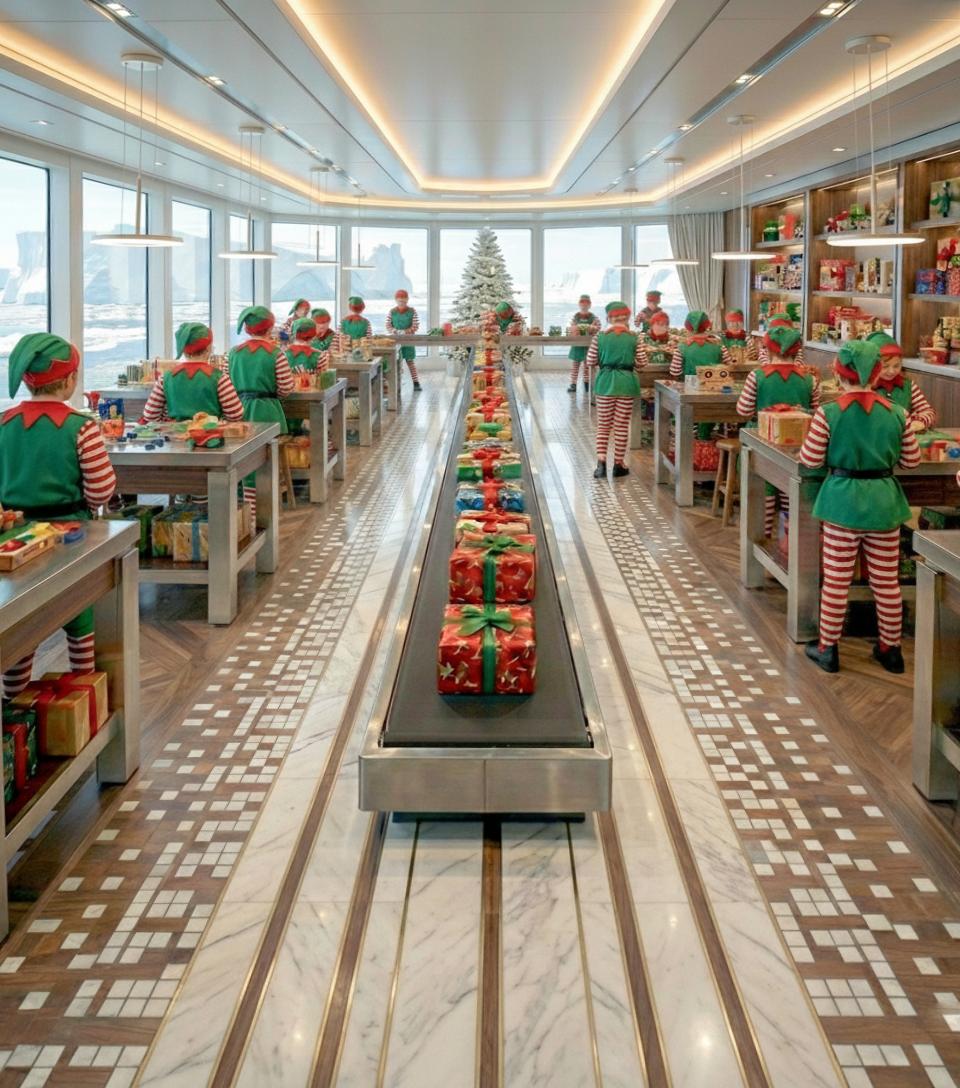
The elves have worked on wooden floors for millennia. Changing the flooring of their workshop was not a decision to be taken lightly.
“We are creatures of habit. Very much so,” Chief Elf Sparkle admitted during one of the first site visits to the old North Pole workshop. “This spruce wood floor is the same kind that hundreds of generations have walked on. It’s home. It’s memory. How do you introduce marble without betraying that?”
During a brainstorming session, Chief Elf Sparkle shared a story. “When a sleigh becomes too old to fly, we dismantle it with care. The wood is never thrown away. Never. It’s wood that has flown, that has seen the world from above, that has carried gifts. It’s kept, waiting for a second life.”
Silence. Then our designer had an idea. “What if that second life were here? In the floor of the new workshop?”
That’s how a wood-and-marble inlay came to life. Spruce planks—reclaimed from sleighs that flew for decades, some for nearly a century—alternate with light marble inserts in a geometric pattern that feels both traditional and contemporary. Wood dominates the individual workstations (the elves prefer the warmth of wood underfoot when they spend hours building.), marble takes centre stage in the high-traffic areas.
We had presented a similar solution at the Monaco Yacht Show the year before. It had drawn significant interest precisely for its ability to combine technical performance with aesthetic warmth.
Hidden Inlays: Details to Be Discovered, Not Displayed
But the most special details of Aurora Borealis—the ones that make even the most seasoned guests say “wow”—are the ones you don’t notice right away. They are small surprises hidden in plain sight, details so discreet and so perfectly integrated into the design that many guests only discover them on their second, third, or even fourth visit. The luxury equivalent of Easter eggs.
Constellations Beneath Your Feet
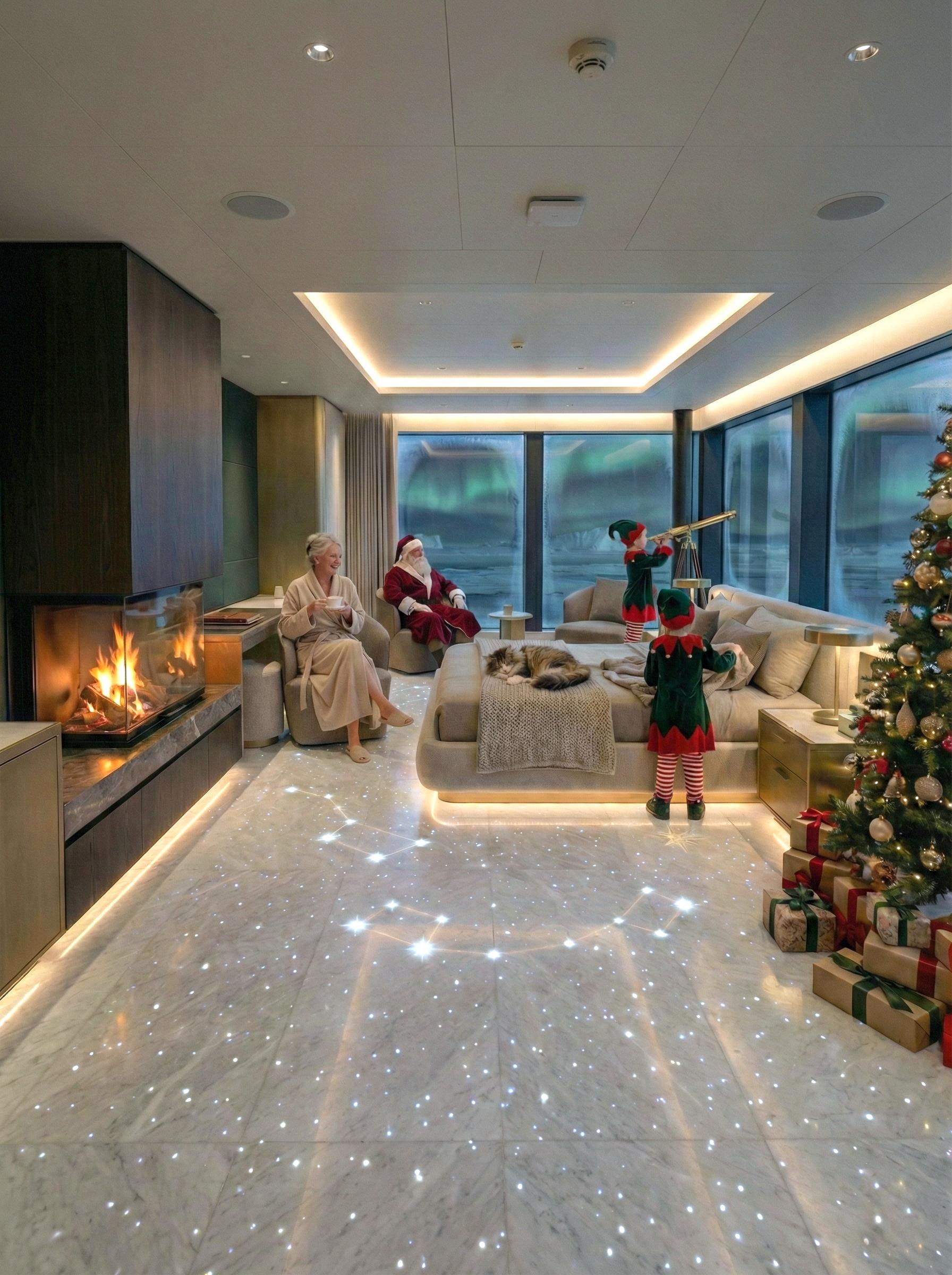
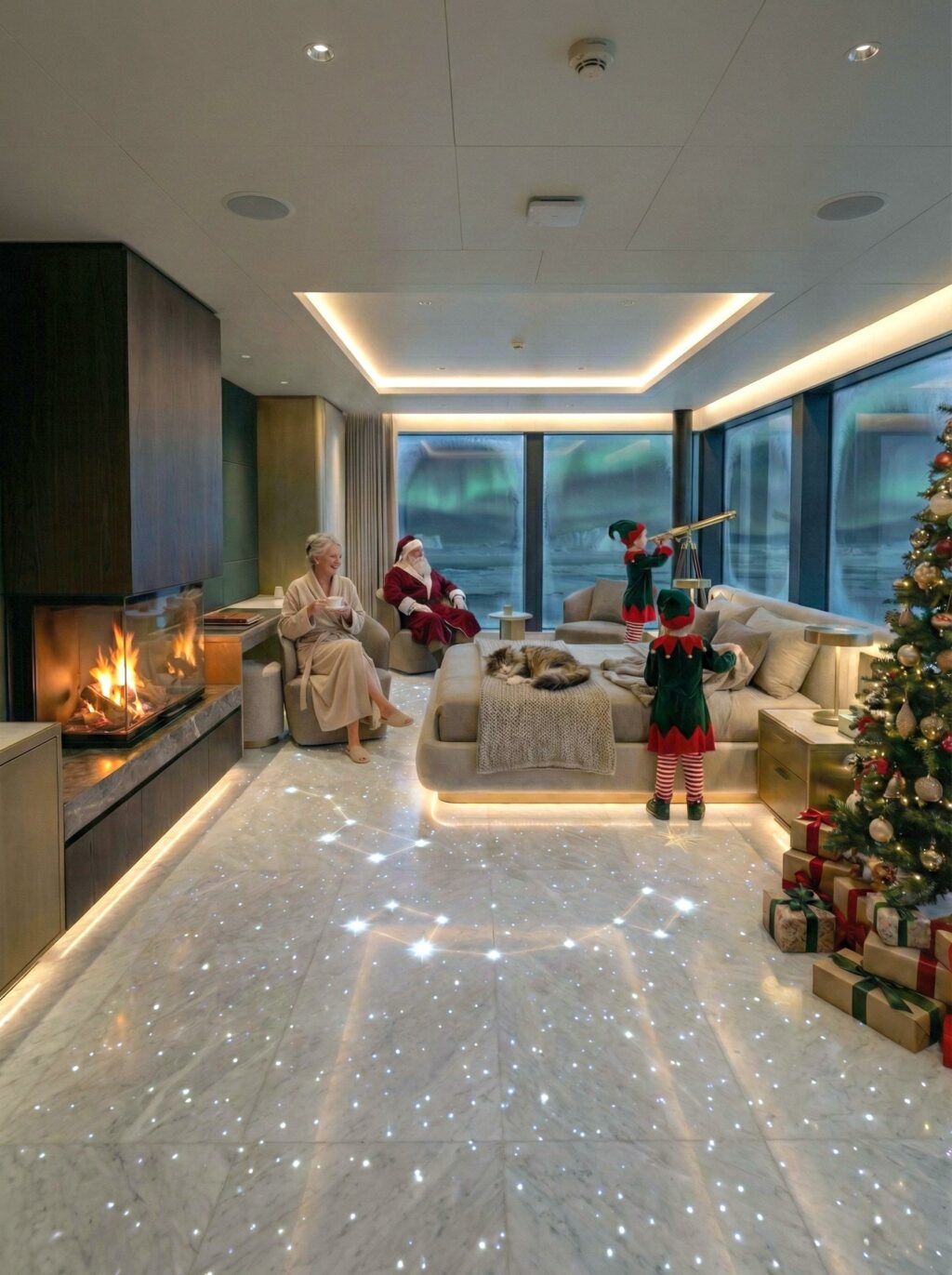
In the floor of the owner’s cabin, a depicts the constellations visible from the North Pole. Ursa Major. Ursa Minor. And, of course, the North Star. By day, it is barely perceptible. At night, with carefully calibrated uplighting, it emerges almost magically. “I discovered it on my third night on board,” Santa says. “There was a particular light on the floor. I stopped and looked more closely. Those are my stars. The ones I see every night from the cottage. You brought them here. I won’t deny that I was moved.”
Invisible Snowflakes
In the main corridor, we inlaid twenty snowflakes. Small, geometric, made from marble just slightly lighter than the background. They look like natural veining. But when the light hits them from just the right angle, they appear one by one. Like walking through a light snowfall—you notice one, then another, then another. Not all at once, but in sequence through gradual discovery.
“This is my favourite corridor on the entire yacht,” Mrs. Claus confides. “I could take the other way—it would be faster. But I always come through here, even when I’m in a hurry. Every time, I discover one I hadn’t noticed before. Or maybe I had noticed it, but I’d forgotten.”
“We wanted Christmas elements without slipping into kitsch,” explains Chief Elf Jinglebell, who coordinated the entire design. “These inlays are meant to be searched for, to be noticed. And every time someone notices them, there’s a small moment of pure wonder. That’s exactly the reaction we were aiming for.”
The most powerful magic is the one that remains invisible.
The beauty of marble is undeniable—magnetic, almost hypnotic. But in an extreme environment like the Arctic, with its polar temperatures, unpredictable humidity and salt that penetrates everywhere, beauty alone is not enough. What was needed was serious, scientific, certified protection.
With one absolute constraint: no one should see it. No one should even perceive it. The marble had to look like natural marble—pure, untouched, intact. The protection had to be there, effective and reliable, yet completely invisible.
Protective Nano-Coating: A Molecular Raincoat for Marble
On all the most exposed surfaces, we applied nano-technology protective treatments, a molecular barrier that protects against stains, moisture and infiltration without altering colour or texture.
“It’s like a raincoat for marble,” explains our specialist technician. “Water beads off, oils don’t penetrate, and stains remain on the surface, where they can be easily cleaned. But—and this is crucial—to the naked eye and to the touch, the marble feels completely natural. The protection is there, but it’s invisible.”
Anti-Slip Treatments Where They Truly Matter
Not only on the reindeer ramp, but in all areas where water or ice could create hazards—entrances, spa areas and exterior decks. Each treatment is calibrated to the specific material and tested by certified laboratories.
“The elves were very sceptical,” says Elf Glimmer, the onboard safety officer. “They thought ‘anti-slip’ meant ‘ugly and rough,’ like industrial flooring. When they saw the results they changed their minds. One of them even tried to slip on purpose on the wet exterior decks. He had to give up: impossible.”

Project Management for a Truly Special Client
Eight months of coordination between Italy, Finland and Norway.
Our project manager (who now has an incredible story to tell at every dinner party) had to synchronize with the elves’ shifts, which follow rhythms completely different from human ones. “I’d never had to align with a toy production calendar before,” he jokes when he talks about it.
Every selected material had to undergo certified testing for Arctic conditions: it had to perform at real temperatures of –40°C, withstand thermal shock (from –40°C outside to +22°C inside), cope with variable humidity (from extremely dry Arctic air to the saturated steam of a sauna), and retain all its properties—mechanical, aesthetic and chemical—under conditions rarely encountered in standard yachting.
“We developed a dedicated testing protocol,” explains our technical director, pointing to charts and tables that look as if they came straight out of a NASA lab. “Repeated hot–cold–hot cycles, 200 times per material, to simulate 20 years of real-world use.” Some stunning marbles were rejected because they didn’t pass these stress tests. We couldn’t take the risk. This yacht is designed to last for centuries. Literally centuries.”
Maintenance? “The Elves Have Other Things to Do”
The elves are busy. Very busy. Their gift-preparation work starts on December 26th and continues non-stop until the following December 24th. They don’t have time for complex maintenance routines, special treatments or delicate care. “We don’t want to think about it. The floor gets dirty? One pass with a mop and it has to look perfect again. A reindeer scratches something? That can’t be an issue. Clear?”
Crystal clear.
Every material choice was guided by this simple but uncompromising principle: absolute beauty, with total low maintenance.
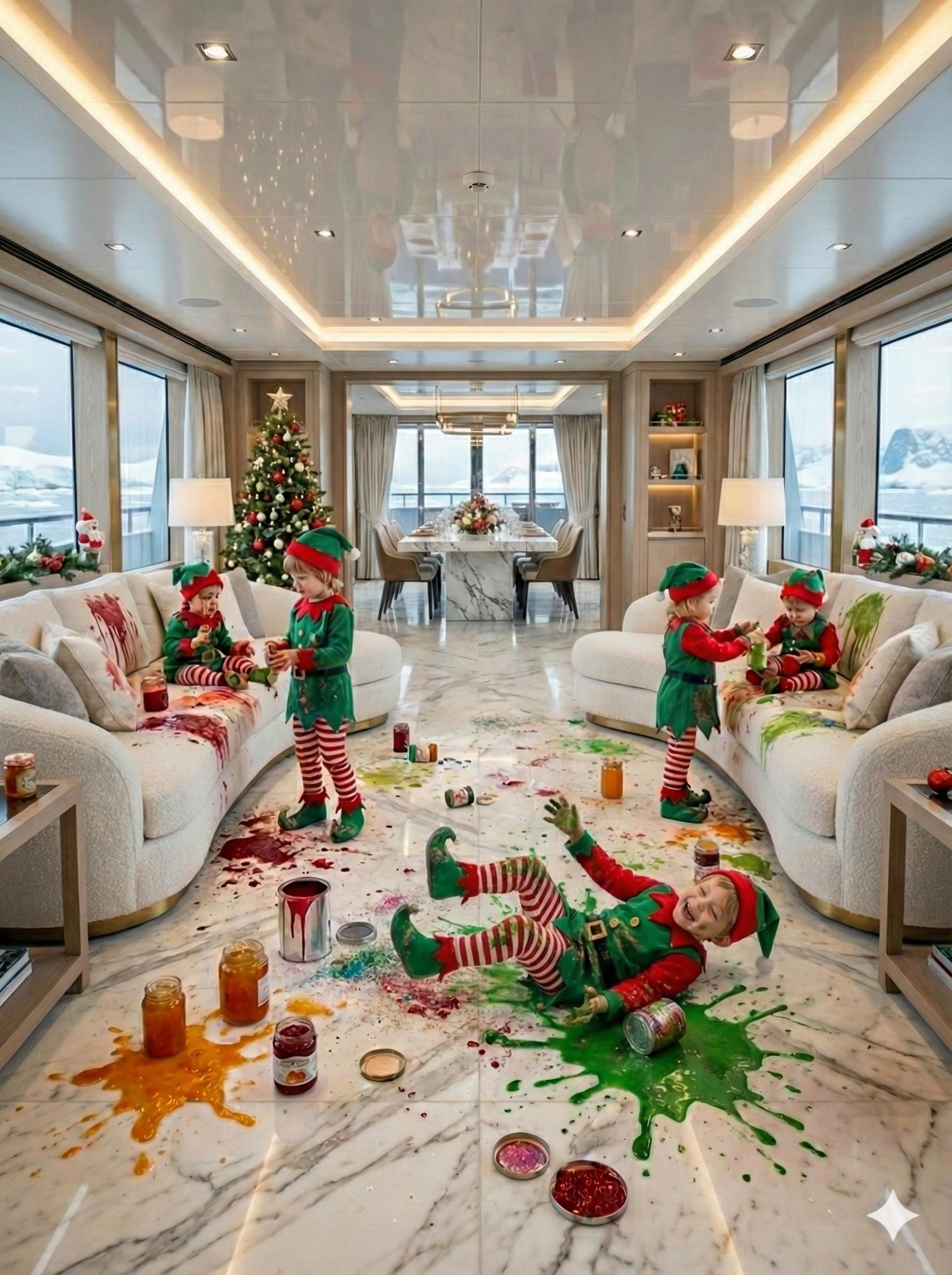
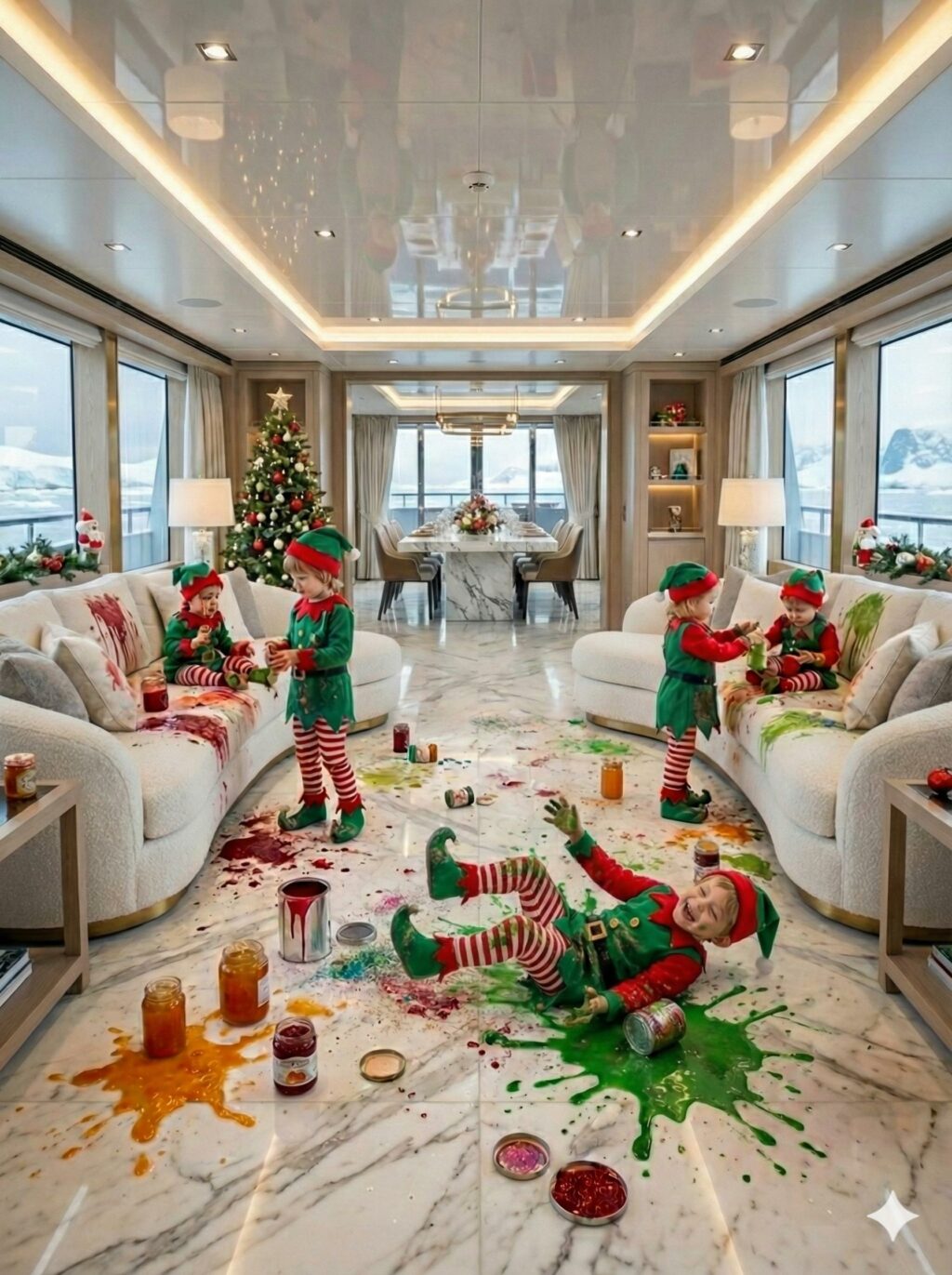
“The final test,” says Elf Twinkle, “was when we brought a group of junior elves—the most chaotic ones, the ones who spill everything—onto the main deck and told them to… just be themselves. Two hours of total chaos. Then we cleaned everything with a regular mop and water. Five minutes. Everything was perfect.”
Mission accomplished.
Launched Under the Aurora: When Even the Sky Gives Its Approval
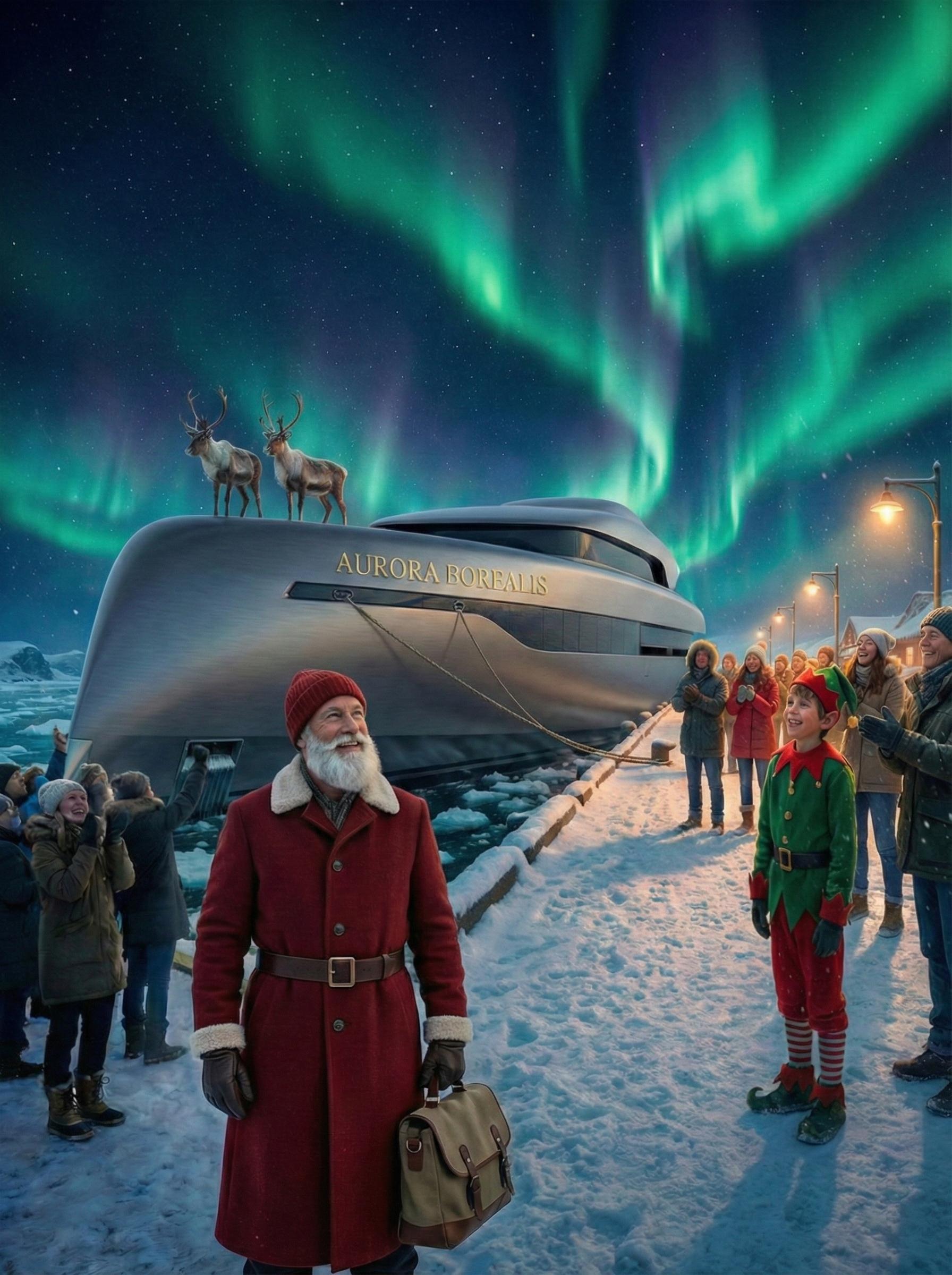
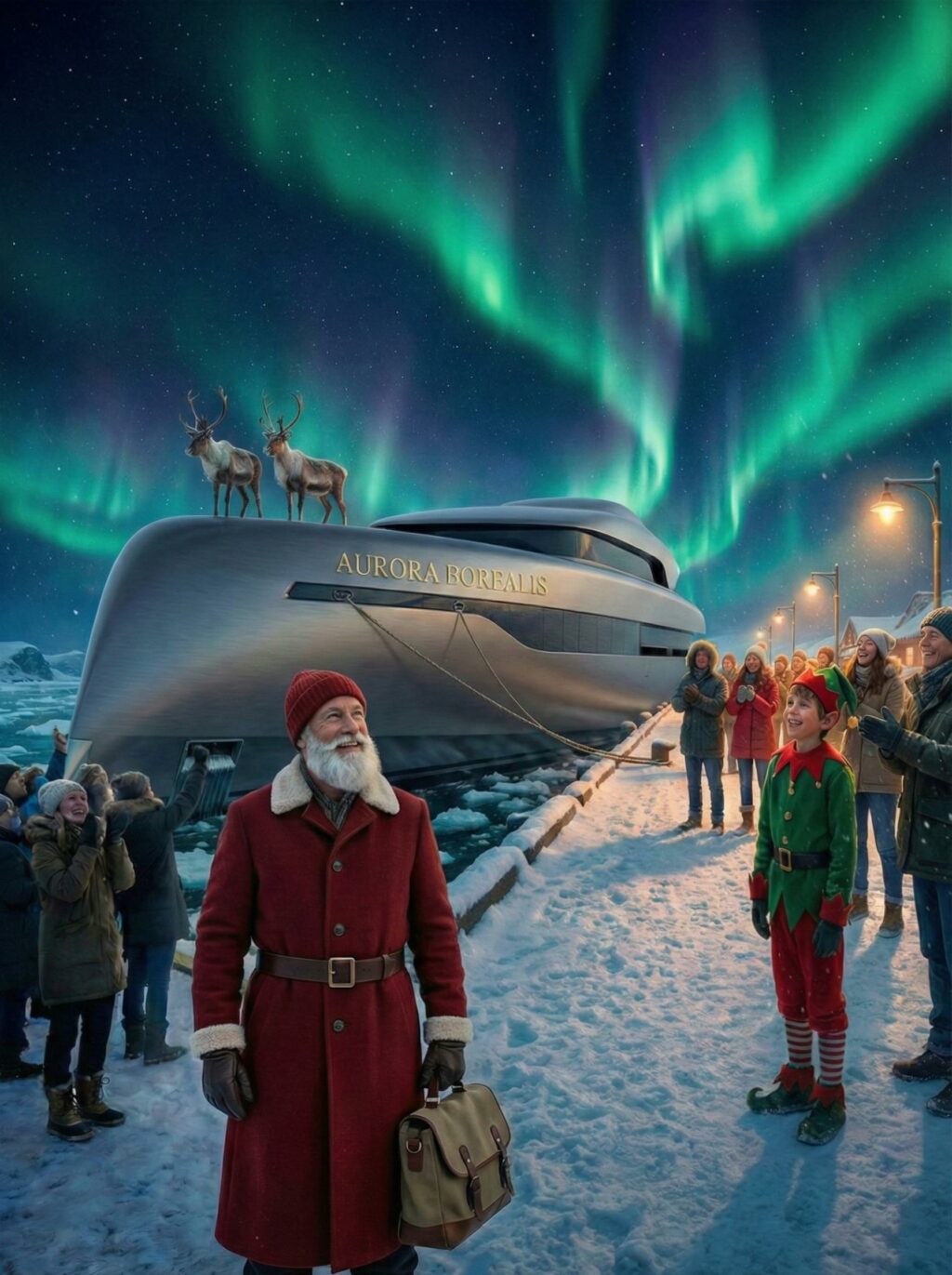
The Aurora Borealis superyacht was launched in late October, on a night that felt straight out of a film. Crystal-clear skies, a temperature of –8°C, and a real aurora borealis dancing overhead, as if it had received an invitation to the launch.
“It’s a sign,” Santa murmured, looking up at the sky with misty eyes. “The aurora is here. It’s welcoming the ship that bears its name.”
The inaugural tour lasted nearly three hours. Santa wanted to see everything, touch everything, test everything.
“You know,” he said at the end, “in 1,750 years of activity I’ve seen many innovations. The telephone, which let me know in advance what children wanted. The internet, which transformed letters to Santa. Just-in-time logistics, which optimized deliveries. But this feeling of walking on warm ice, this attention to every single detail… this is truly special. You understood that even magic needs solid foundations. And beauty.”
Your project? (Probably without reindeer, but with equally real challenges)
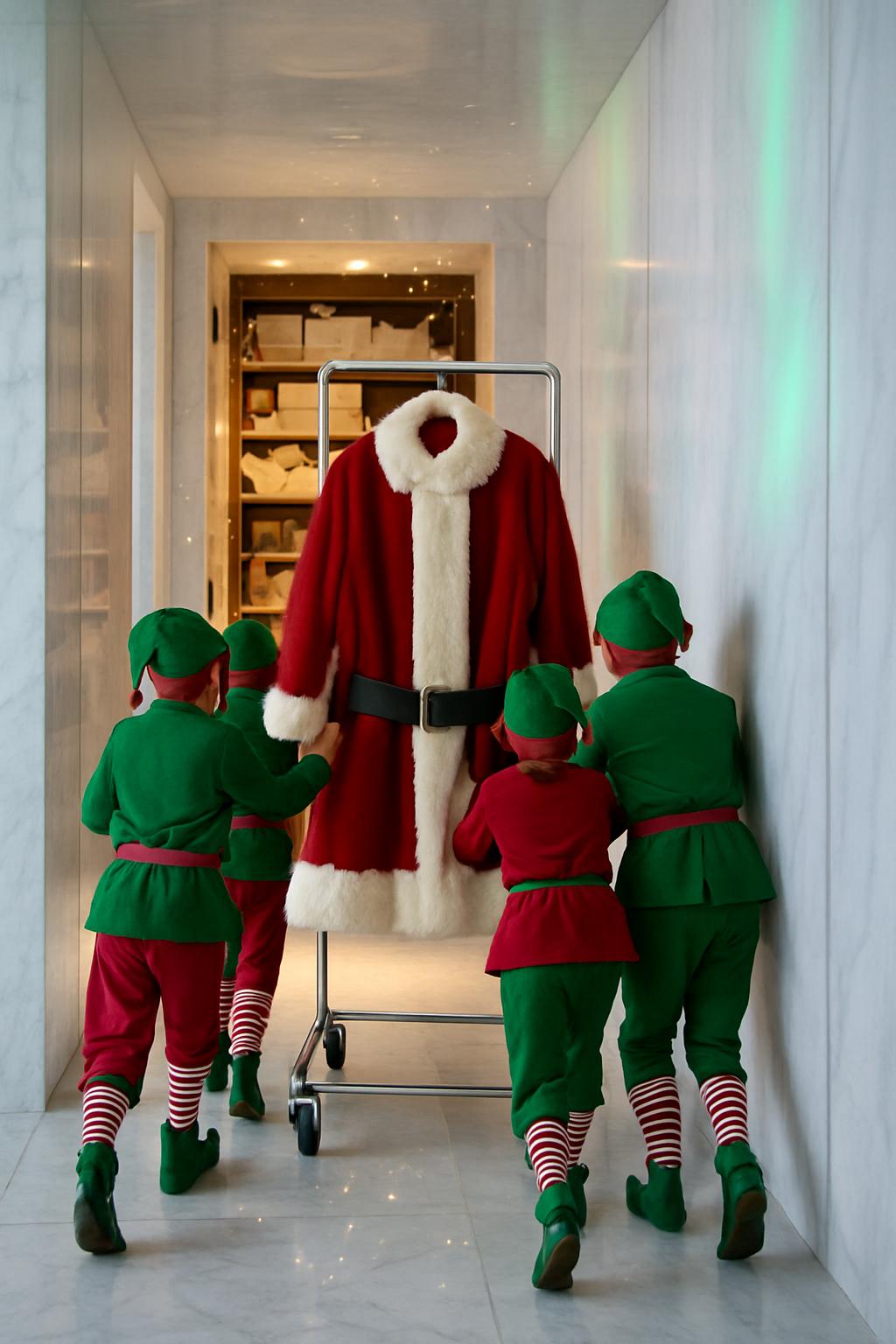
Your project, most likely, won’t involve reindeer or sleigh take-offs. You probably won’t have to worry about auroras or –40°C resistance (we hope).
But the challenges are always real: marine environments, the need for lightweight solutions, the desire for uncompromising luxury without sacrificing functionality, materials that last and age gracefully, and bespoke details that make a space not just beautiful, but truly and unmistakably unique.
Whether your yacht sails the sunlit Mediterranean or Arctic waters, Marmi Vrech is ready to turn every technical challenge into an opportunity for beauty. We don’t promise literal magic (we leave that to Santa), but results that feel magical when experience, technology and passion come together.
If Santa chose to cross half of Europe to come to us, there’s probably a reason.
Season’s greetings from everyone at Marmi Vrech
And if, on Christmas Eve night, you hear a noise on the roof—a rustle, a faint jingle—it’s probably just the wind. Or a cat.
Or maybe—just maybe—it’s Santa personally checking that his new Santa Fiora deck is really as non-slip as we promised. Even after 500 landings, even with wet hooves, even when Rudolph pulls off that acrobatic manoeuvre he really shouldn’t—but does anyway, because he’s Rudolph.
Spoiler: it is. It’s non-slip. We tested it 1,000 times. But Santa prefers to check personally. He takes quality control very seriously.
P.S. Mrs. Claus called us last week to ask for a quote for the North Pole cottage. Apparently, after seeing the yacht, the old wooden house “just isn’t the same anymore.”