Getting Natural Stone Specifications Right: The Decisions You Can't Put Off
The sample was approved, the stone is the one specified, and the finish matches what was specified. And yet, when the slabs arrive on site, something doesn't add up.
A vein far bolder than anyone expected. A tone that, across a full wall, reads differently from the sample chosen in the studio. A finish that, under the real light of the room, produces an effect quite unlike the one imagined at a desk.
Anyone who works with natural stone day in, day out knows these moments well.
They're rarely down to one glaring mistake. More often, the problem traces back to something that was never fully decided: a material characteristic assessed at the wrong scale, information left implicit, an adjective — "uniform," "matte," "just like the sample" — read differently by the designer, the contractor and the supplier.
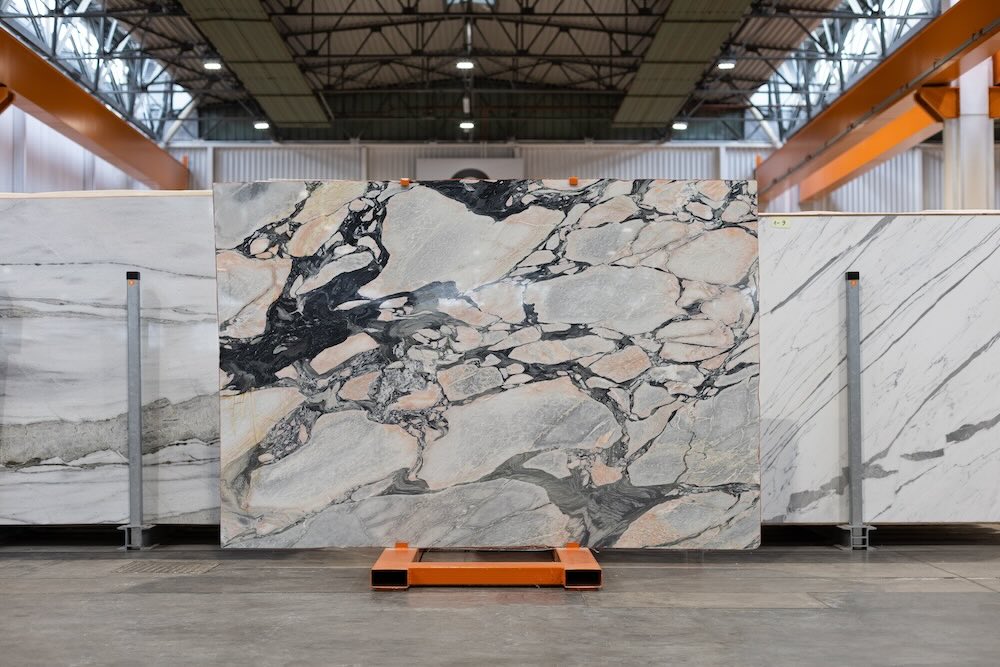
With natural stone, this risk is magnified, because we're not dealing with an industrial product designed to be identical from one piece to the next. Every slab holds colour variation, veining and stratification that belong to its own geological history. These aren't flaws to be engineered away — they're characteristics to understand, select and manage before the material ever enters production.
This is why a specification is never just the technical document needed to start production. It's the first real act of designing with stone.
It's the moment where aesthetic intent meets the real use of a space, the behaviour of the material, what the material can realistically be made to do, and the expectations of everyone who will approve, build and eventually live with the project.
In more than sixty years in business, we at Marmi Vrech have watched the same issues resurface across very different settings: superyachts, private residences, hotels, retail.
And we've learned that most of these problems can be avoided simply by getting the right information across early enough.
These are the eight decisions that, in our experience, make a specification watertight — and help head off problems once a project moves into production.
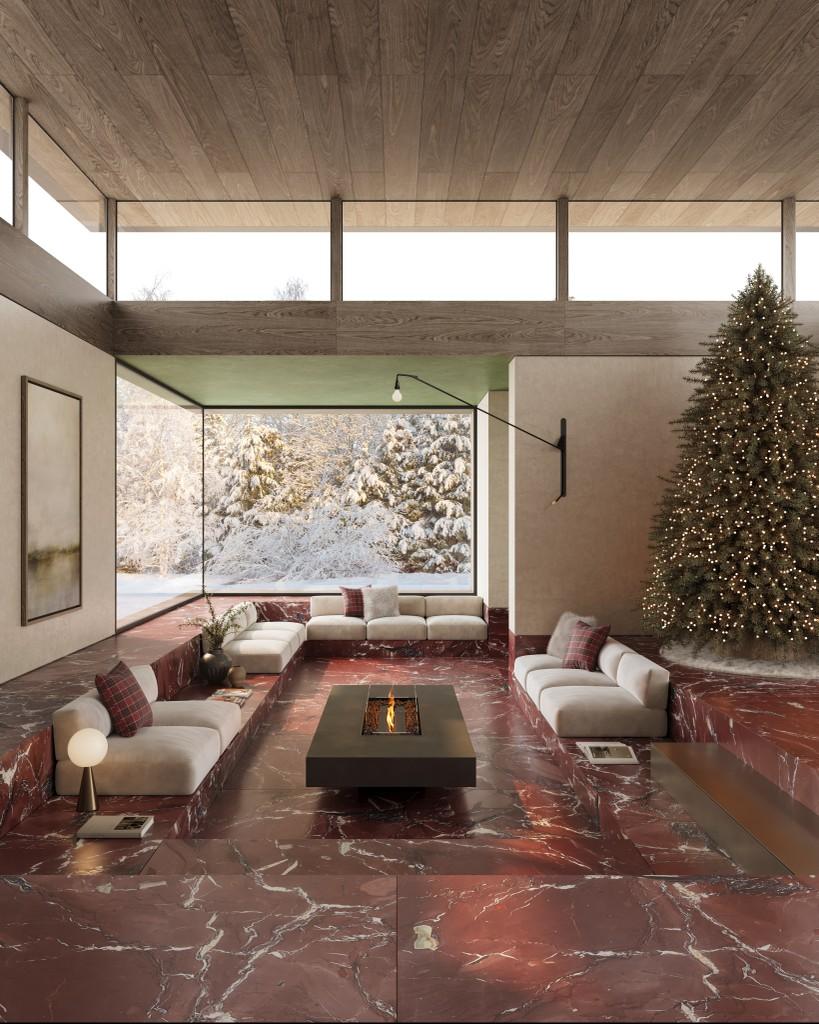
1. Start from the people and the real use of the space
Saying "We'd like this marble for the bathroom" is a starting point, not a specification.
A private bathroom in a residence, a suite bathroom in a hotel, the spa of a superyacht, and the powder room of a Michelin-starred restaurant all put surfaces through very different conditions. Frequency of use, contact with water and cosmetics, the cleaning products involved, foot traffic, the maintenance regime required — all of it changes, even when the starting block of stone is exactly the same.
Something else changes too: the emotional experience the space is meant to deliver.
Material choices are never neutral. Colour, veining, texture, sheen, and the way a surface absorbs or reflects light all shape how a space is perceived as a whole.
An owner's cabin calls for intimacy and calm. In a hotel lobby, the material can help create a strong first impression and make the space memorable. A flagship store has to speak the brand's language. A wellness area contributes to a sense of comfort, safety and hygiene.
A strongly decorative marble can be a stunning focal point — and feel like too much once it covers every surface. The same stone, polished versus honed, can take on an entirely different character.
For us, knowing this from the outset is essential: it lets us evaluate a material in its real context, not just for how it looks in isolation.
Intended use and operating conditions, then, shouldn't be left implicit in the specification.
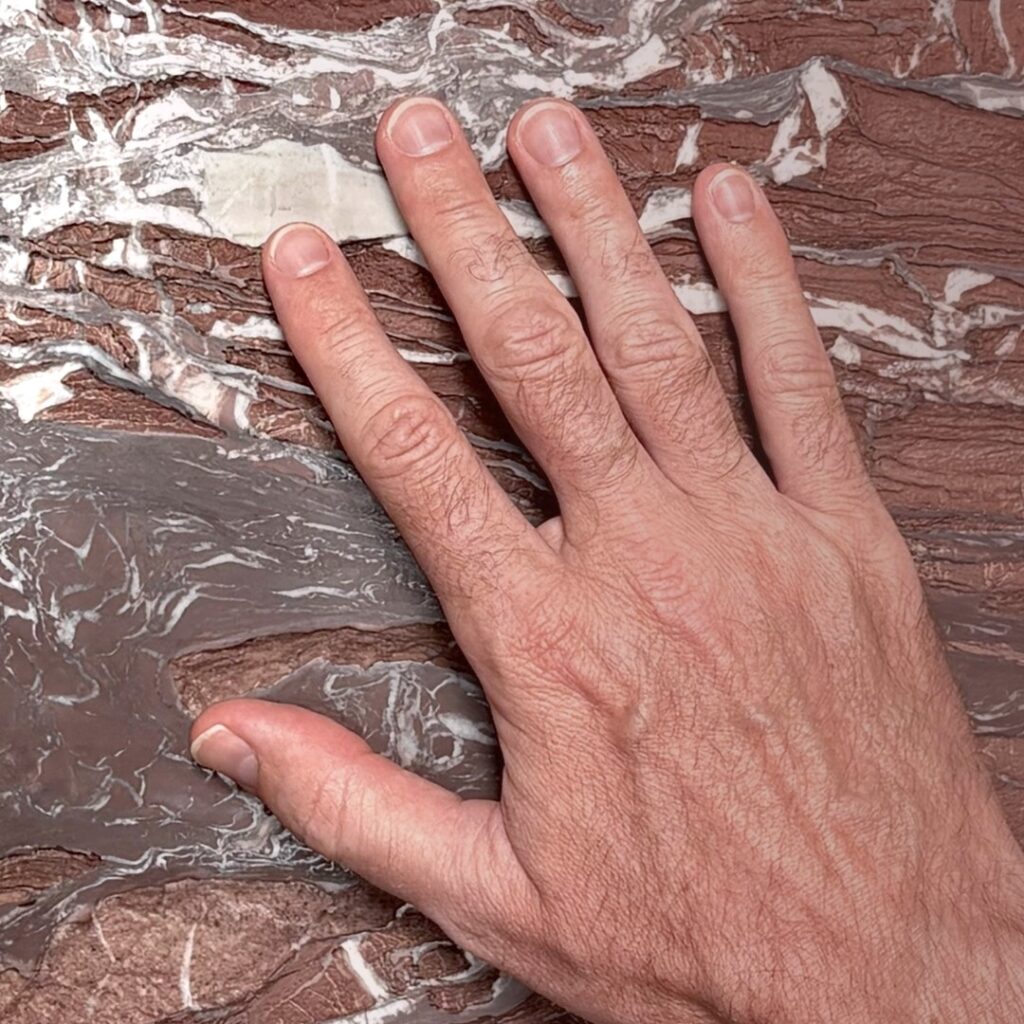
2. Choose a real stone, not a picture of one
Material selection almost always begins with a visual reference: a photograph, a texture dropped into a render, a page saved to a mood board.
That's only natural. The trouble starts when that image becomes the technical specification.
Two materials that appear to answer the same brief can behave very differently. Marble, granite, quartzite, onyx and other stones differ in porosity and absorption, resistance to wear, sensitivity to certain substances, and their response to different finishes and treatments. Even within the same family, two materials can call for entirely different assessments.
So the question isn't simply whether a stone is beautiful. It's whether it suits the intended use, whether it can be worked the way the project requires, which finishes it can take, and what maintenance it will demand over time.
These are checks that are far more useful to run while the choice is still open.
Receiving a specification once the material has already been approved by the client and locked into the renders drastically narrows the room to manoeuvre. At that point, all we can do is check feasibility — often while managing compromises.
If we're brought in during selection instead, we can put aesthetics, performance and feasibility on the same table: flag a risk, verify a tricky operation, suggest a better-suited finish, or propose an alternative that stays true to the project's language.
Involving the supplier at this stage doesn't mean handing over the creative decision. It means adding, to the designer's vision, the knowledge of the people who will actually select and work that stone.
In the specification, it's worth identifying the material precisely and, where relevant, stating the performance required and the criteria for evaluating any alternatives.
3. Look at the whole slab before you look at the sample
A designer approves a twenty-centimetre sample. Months later, they see the finished wall and object to a large dark vein running through it.
The material hasn't changed. The scale at which it's being viewed has.
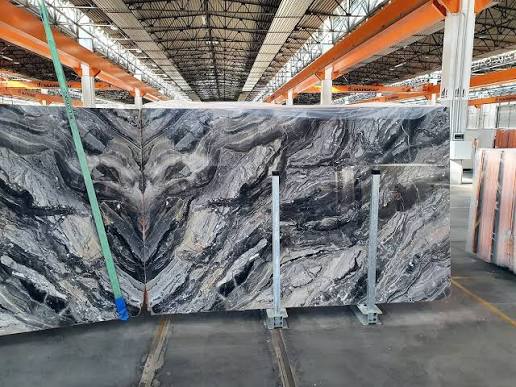
A physical sample is excellent for judging finish, colour and the tactile quality of a surface. What it cannot reliably show is the scale of the veining, the internal colour variation across a slab, the balance between light and dark areas over a large surface, or the natural differences between one slab and the next of the same material.
With more uniform stones, the gap between sample and slab can be small. With decorative marbles, quartzites and materials with bold veining or strong colour variation, that gap can become enormous.
We touched on this limitation in an earlier piece on the variability of decorative marbles: a pattern that unfolds across metres simply can't be represented faithfully by a sample a few centimetres wide.
Force that simplification, and you get one of the most common misunderstandings in the business: the material delivered is correct, but it doesn't match the mental image built from the sample.
That's why, whenever possible, we prefer to start from the slab.
First, we look at the material at its real scale, through complete, high-resolution photographs of the slabs actually available. Then we assess variability and how well it suits the project, and use the physical sample for what it does best: finish, feel, true-to-life tone, and how it relates to the other materials in the space.
This isn't about giving up on sampling — it's about using it for the decisions where it's genuinely irreplaceable.
There's another advantage too. A sample has to be cut, prepared, packed and shipped, and a suitable offcut doesn't always already exist. Starting from slab imagery cuts down on unnecessary sampling, cutting and shipping — while improving the quality of the selection at the same time.
Where variability is significant, the specification should account for it: approval can't rest solely on a small sample. It has to consider the characteristics of the slabs that will actually be used.
4. State quantities, dimensions and the aesthetic continuity you need
A hundred square metres of the same marble isn't simply a hundred times one square metre. Scale changes the nature of the problem.
An exceptional slab might be perfect for a single vanity top. If that same material has to clad the floors and walls of an entire project, the level of planning required is completely different.
To put together an accurate technical proposal, we need to know from the outset not just which stone, but the overall quantities, the formats required, and the level of aesthetic continuity expected.
There need to be enough slabs, compatible with the formats to be cut. It has to be verified how much visual consistency is achievable, whether the project calls for bookmatching, specific sequencing or particular vein pairing — and an adequate margin has to be planned in for machining and any replacements.
Quantity, then, isn't just a figure needed for the quote. It directly determines whether the project is aesthetically feasible.
Variability, too, can be managed as a design choice. On some surfaces, differences between slabs can become part of the composition; on others, the priority is maximum continuity.
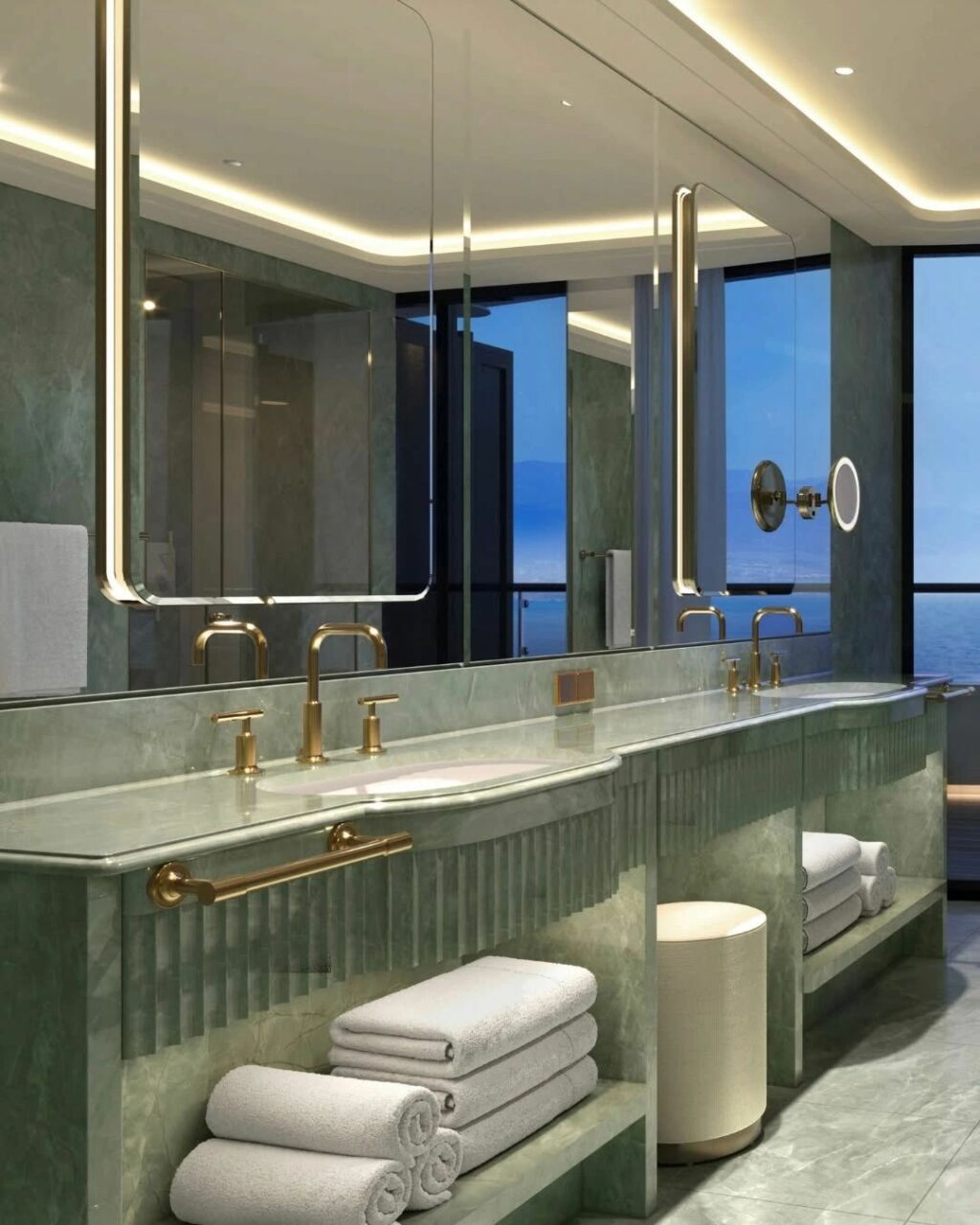
A project like Four Seasons I, with ninety-five suites and over a thousand square metres of quartzite for the bathrooms alone, shows just how much scale can turn slab selection into a genuine design problem. Achieving that level of colour consistency at that scale demands planning that starts well before the first cut.
For this reason, the specification should state total quantity, the formats that matter, the pairing criteria, and — where it matters — whether the material needs to come from the same lot or block.
5. Verify real availability before locking the project in
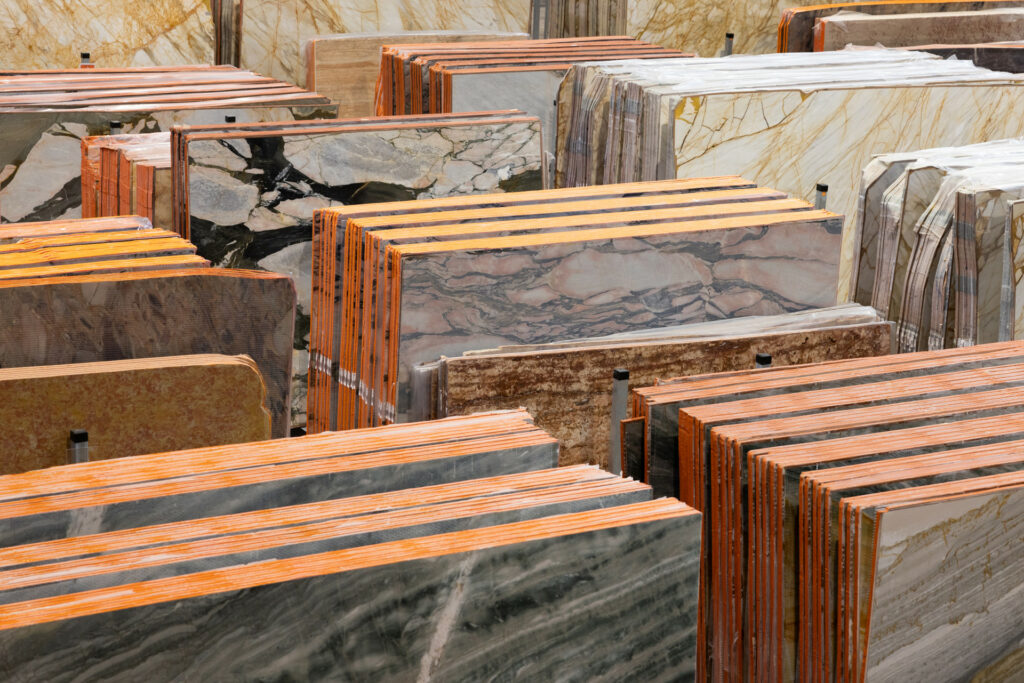
Specifying a stone without checking its availability means building renders, mood boards and approvals around something that, in the quantity and conditions required, might simply not exist.
A material can appear in a catalogue and still not be available in the quantity, quality or size needed.
Between the moment a stone is chosen and the moment it enters production, months can pass. Availability can shift in the meantime. And finding a few slabs under the same name isn't enough — what's needed is sufficient quantity, adequate quality, compatible dimensions, consistent aesthetics, and timing that fits the schedule.
This is a check we prefer to make as early as possible.
Discovering a shortfall right before production is a problem that ripples through the entire supply chain. It forces everyone to find alternatives, redo renders, reopen negotiations with the client, and retest finishes and chemical treatments from scratch — all while deadlines close in and fixed costs climb.
The sooner we know the material, the quantity and the timeline, the sooner we can tell whether the project is based on material that is actually available, rather than on a catalogue reference.
This, too, deserves a place in the specification: a step to verify the slabs actually available, and a procedure for approving any alternatives.

6. Treat finishes, treatments and maintenance as one system
The final surface is the result of material, fabrication, treatment and conditions of use all coming together. Treat these as separate decisions, and you risk choices that are correct individually but don't add up to a coherent whole.
A finish doesn't just change how a stone looks. It changes how the surface reflects light, how it feels to the touch, how colour is perceived, and, in some cases, how it performs in daily use.
Polishing, honing, brushing, bush-hammering and more textured finishes can produce very different results on the same material.
To choose correctly, we need to know where the surface will be used and what conditions it will face.
Some applications involve water, oils, cosmetics, food and detergents. Outdoors, weathering and UV exposure come into play; on a yacht, salt spray as well.
The same goes for surface treatments. There's no universal solution to apply indiscriminately to any stone: protection has to be chosen based on the material, its level of absorption, the finish and the intended use.
Slip resistance deserves separate consideration — wet areas, outdoor paths, pool edges, staircases.
If this requirement is stated upfront, we can evaluate material, finish and treatment together. If it surfaces only after the aesthetic has already been approved, it can mean reopening a decision that was already settled.
And then there's maintenance. A surface gets touched, wetted, walked on and cleaned every day. A finish that's beautiful but too delicate for the intended use, or a treatment incompatible with the maintenance regime ahead, doesn't solve the problem — it just pushes it further down the road.
In the specification, then, it's worth treating finish, protection, required performance and maintenance as parts of the same system.
7. Manage changes, responsibilities, timelines and logistics
In the course of a luxury project, changes along the way are simply part of the process. The problem arises when they're treated as if their consequences stop at the point where they occur.
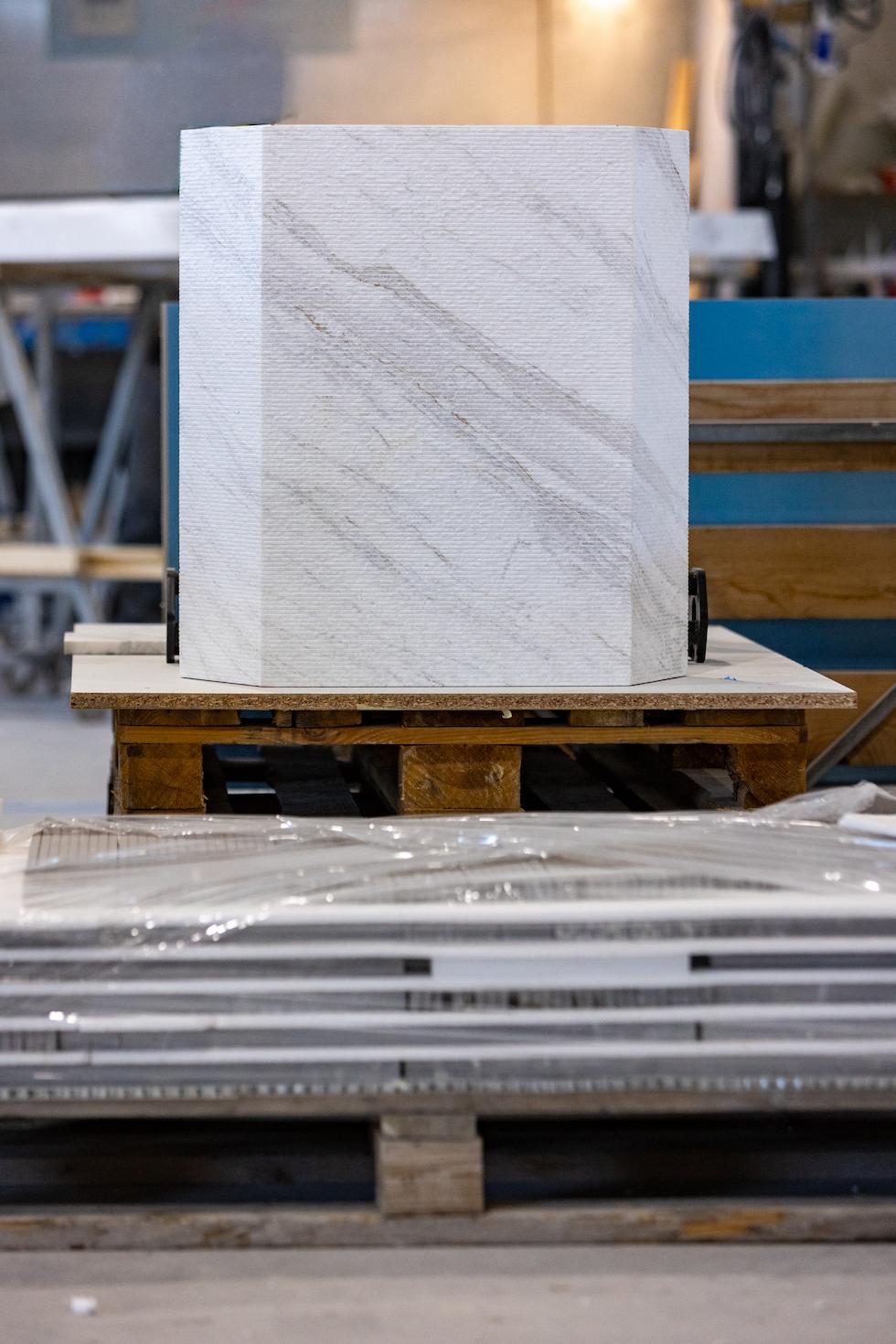
Swapping a stone can affect slab availability, aesthetic result, machining, treatments, cost and timeline. A new finish may require testing or fresh samples. A change in dimensions can alter how a slab is cut — and therefore how much material is needed.
That's why, when a specification changes, the checks tied to that specification need to be reopened too.
This doesn't mean you can't change your mind. It means a change shouldn't be considered settled until its production consequences have also been assessed.
It's one of the reasons ongoing coordination between designers, contractors, technical departments and supplier matters so much. In an earlier piece on working with contractors, we wrote about the difference between being a supplier and being a partner. Here, that principle translates into something very concrete: if we learn a specification has changed as soon as it happens, we can assess the effects right away.
The same goes for timing and logistics.
To plan production and delivery, we need to know the real deadlines — but also the conditions under which the material will need to arrive and be handled.
The size and weight of the pieces, packaging, site access, available equipment and delivery sequencing can all shape production decisions from an early stage.
In yachting, these interdependencies are especially visible: access can be limited, handling has to be coordinated with other work happening on board, and delivery windows can be extremely tight. But the same principle applies to a hotel with a fixed opening date, a flagship store with a scheduled delivery, or a residence with an already-defined sequence of works.
The sooner we know the timeline, the constraints and the logistical conditions, the better we can organise production and delivery around the reality of the site.
Approval roles, deadlines, change management and the main logistical conditions, then, deserve to be clarified upfront — not reconstructed once the problem has already reached production.

8. Choose your partner by looking beyond price
A well-made specification reduces risk. But there's another decision that can weigh just as heavily on the final result: choosing the partner entrusted with the stone.
When comparing quotes, it's natural to focus on the bottom line. That's an important number — but in natural stone, taken on its own, it can be misleading.
Two seemingly comparable quotes can hide very different levels of service. One might cover only the supply of material; the other might include slab selection, availability checks, technical support, format planning, cutting optimisation, sampling, mock-ups, finish coordination, production oversight, packaging, logistics and support in managing changes.
These activities often don't appear as a separate line item on the quote. Yet they carry real value, because they reduce the risk of a problem being discovered only after the stone has already been ordered, fabricated, or delivered to site.
The lowest price, then, can create an illusion of savings. If some of these checks are missing, the cost simply shifts further down the timeline: new sampling, revised drawings, extra material, rework, replacements, delays, rush shipping, hours of coordination, and the handling of disputes. The starting price was lower — but the total cost of the project can end up far higher.
That doesn't mean the best offer is always the most complete, or the most expensive one. It means understanding clearly what each quote actually includes, and what level of responsibility and support the partner is taking on.
So when comparing two quotes, beyond "How much does the stone cost?" it's worth asking: Who helps verify that the chosen stone is genuinely available? Who checks that the slabs match the aesthetic expectation? Who verifies feasibility before production? Who manages a change? Who supports us if a problem comes up? And what would it cost the project if these activities had to be handled separately, by someone else?
These are less visible than price, but they're often exactly what separates a simple supply arrangement from a genuine project partnership.
In evaluating a partner, then, price should be read alongside what comes with it: expertise, selection skill, oversight, coordination, reliability, technical support, and the ability to prevent problems before they become costs.
Because in natural stone, you're never buying just a material. You're also, implicitly, buying the ability to turn that material into the exact solution the project calls for.
We can't engineer variability out of natural stone, and there would be no point trying. It's exactly that variability that makes every surface different, recognisable, one of a kind.
What we can do is reduce the ambiguity around it.
There's no perfect specification that fits every project. But there is information that, shared early enough, lets us work better — and lets our clients avoid corrections, additional approval rounds and problems that could often have been prevented.
When a dispute surfaces after the material has already been worked, its root cause can often be traced back to an earlier stage: a decision that got postponed, a piece of information that seemed obvious to one person and wasn't to another.
A well-written specification reduces delays, changes and misunderstandings. But above all, it protects the integrity of the design idea.
It ensures that the stone imagined by the designer, the one evaluated by the contractor, the one selected and worked by Marmi Vrech, and the one people will eventually see, touch and live with, stay — as far as possible — the same stone.
That's why we've turned the eight points in this article into two practical checklists: one for designers at the specification stage, and one for general contractors and technical offices, for when that specification becomes procurement, production and site work. It's a tool for understanding what's already been decided, what still needs verifying, and what to share with us before production begins.
Natural stone should leave room for uniqueness — not for misunderstanding.