The Illusion of Simplicity: A Green Onyx Counter for a Flagship on Rodeo Drive, Beverly Hills
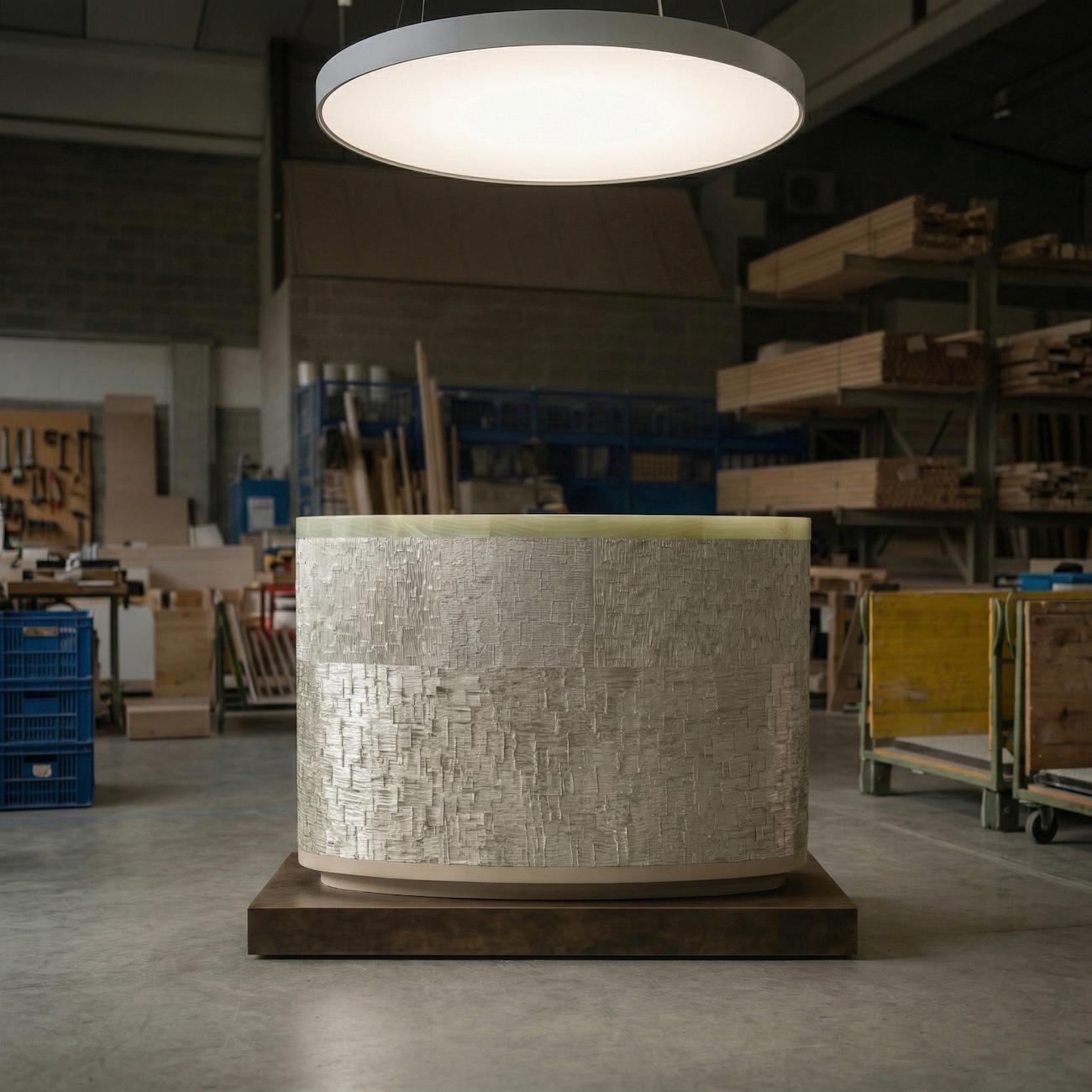
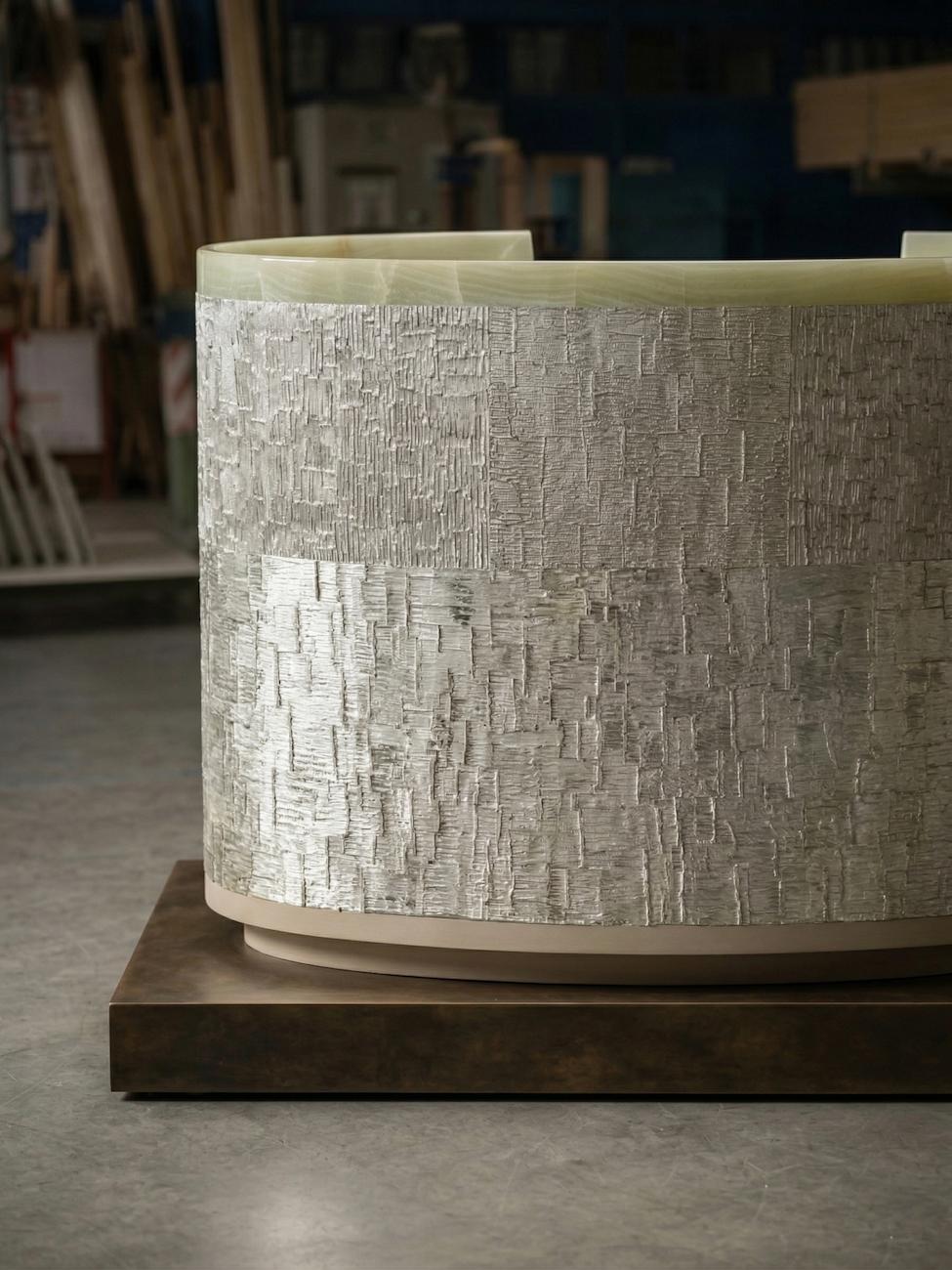
In interior design, simplicity is rarely simple. The cleaner the volume, the more seamless the surface, the less visible the joins, the more work has usually gone into making it all feel effortless. The solid Green Onyx counter created for a new international luxury flagship on legendary Rodeo Drive in Beverly Hills, is a telling example.
Looking at it, you would never guess how much it took to make.
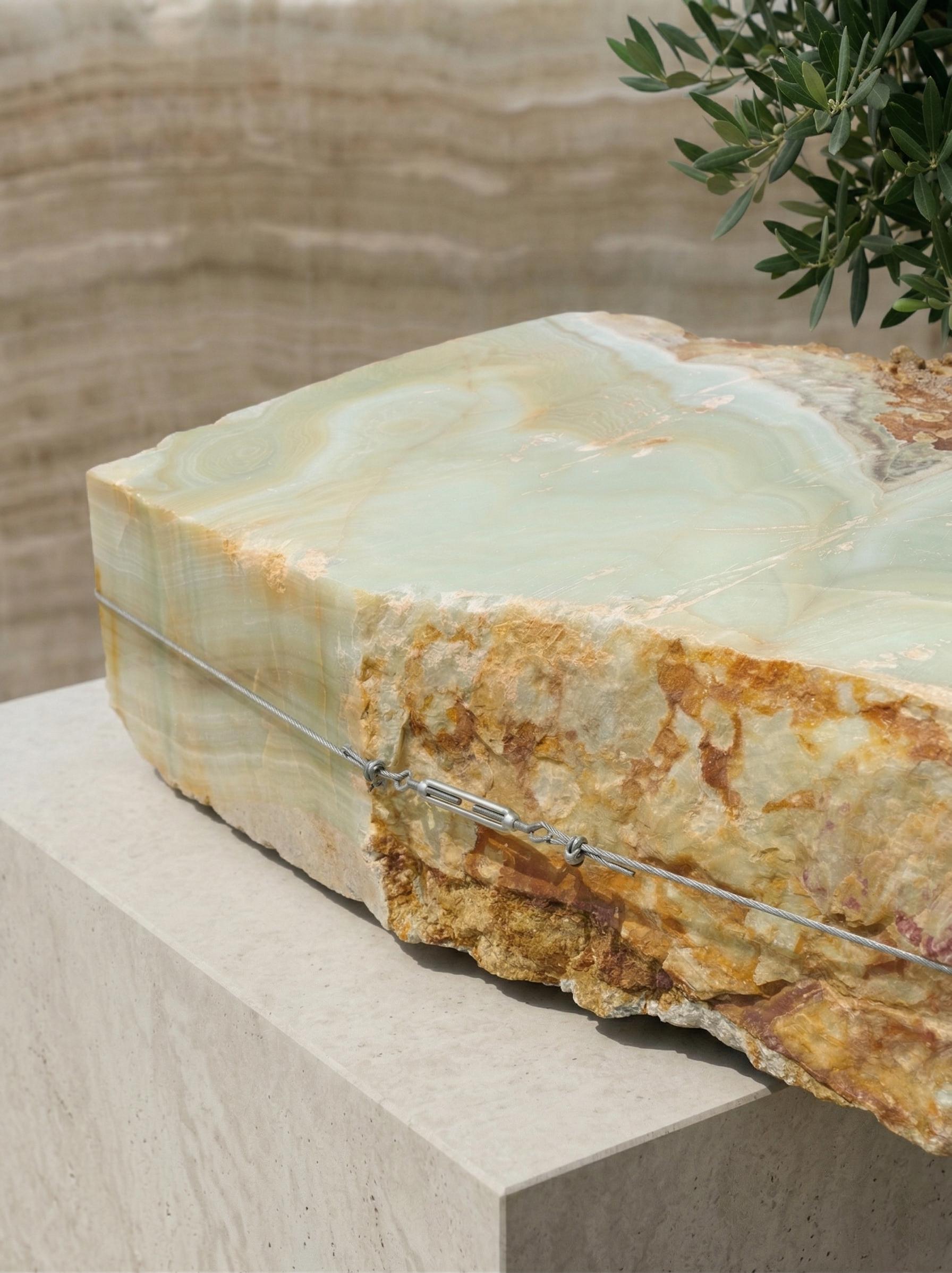
The project came in when the timeline was already tight. The client’s regular suppliers had been unable to guarantee delivery, not for lack of willingness, but because sourcing a suitable block of onyx and carrying out a fabrication process of this complexity was far from straightforward.
”By the time we were contacted, the available options had already run out,” says Feliciano Misceo, Business Development Manager Italy. ”They needed a fast solution for a piece that simply could not allow for compromise, either aesthetically or technically. We decided to take on the challenge fully aware of what it involved.”
You do not just find the right block.
You choose it.
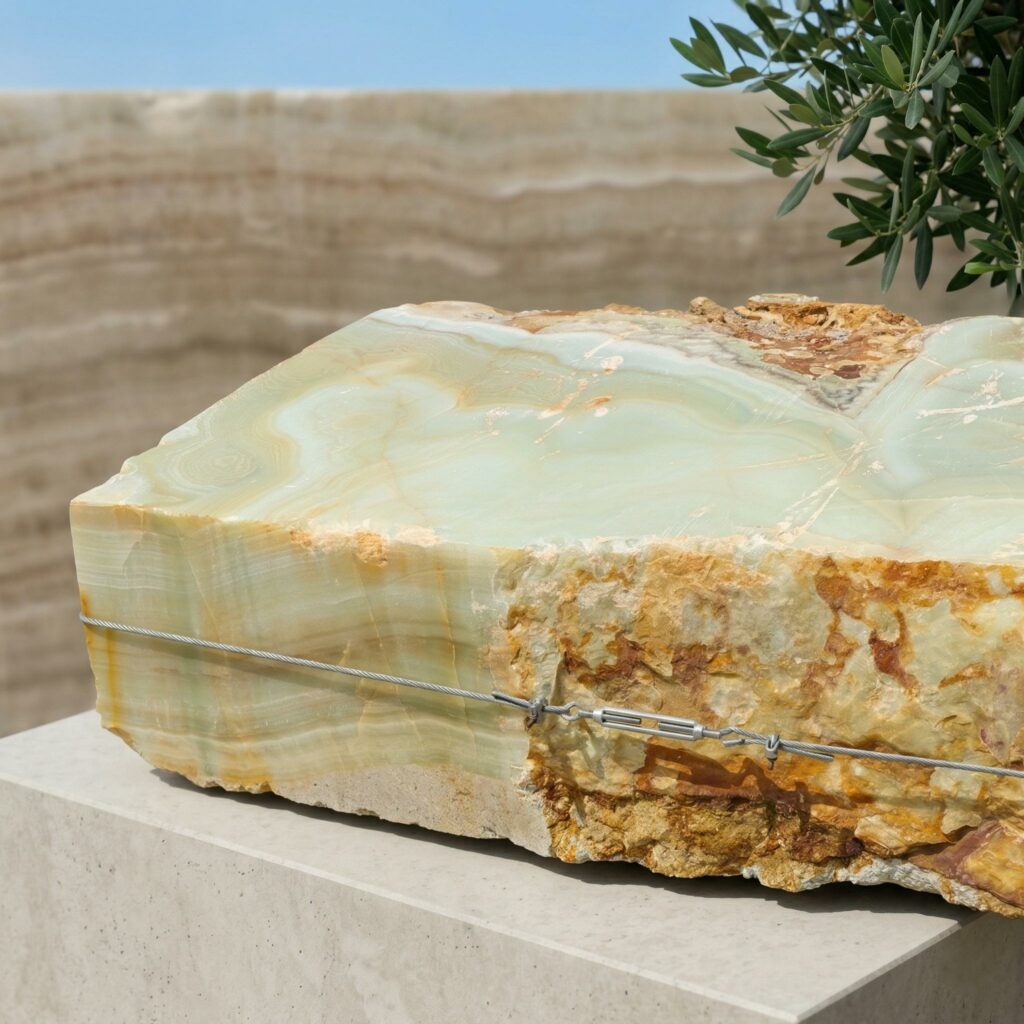
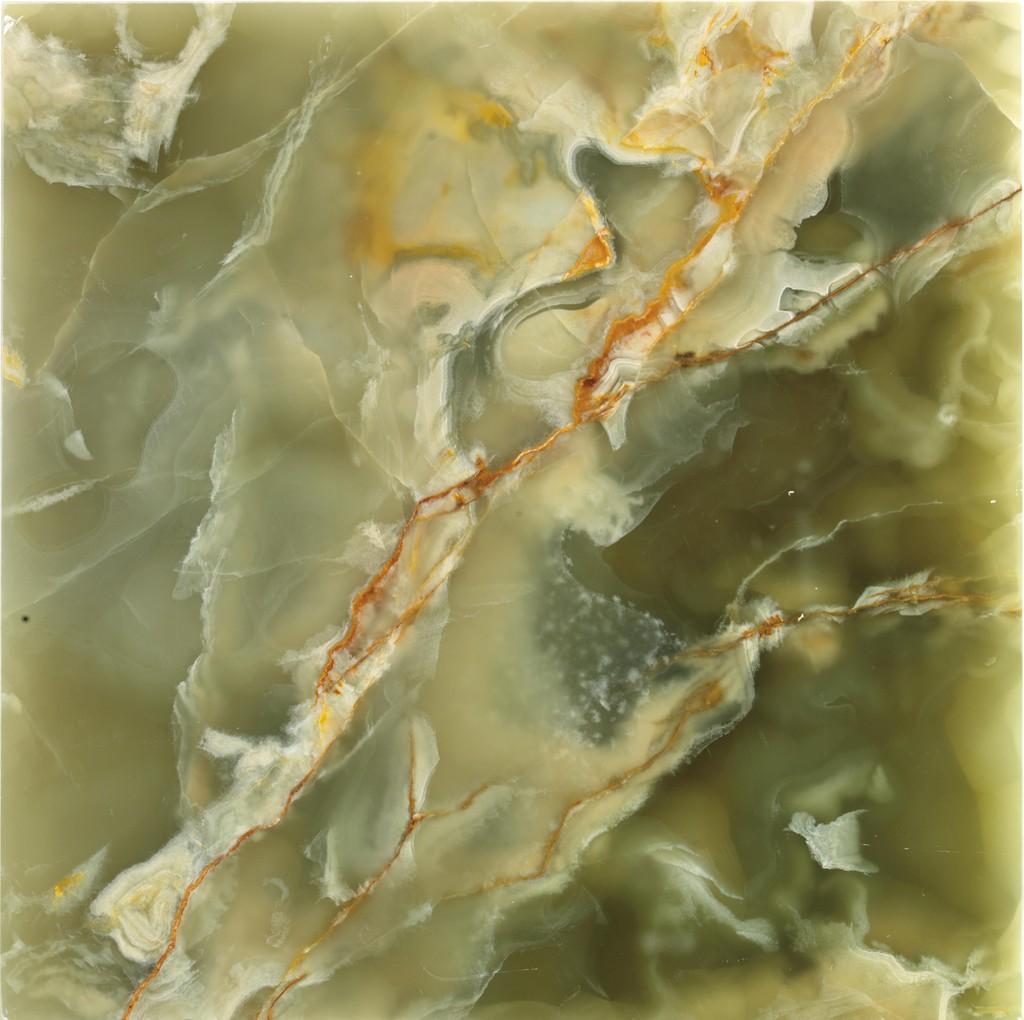
Onyx is a layered, translucent stone that catches light and gives it back from within. But it is also a demanding material, one that can hide internal stresses, micro-fractures and irregularities that don't always show up at first inspection, yet can emerge at exactly the most delicate stages of production.
This is why selecting the block is never just a preliminary step to be rushed through. It is already part of the project. In the case of a counter carved from solid stone, where the final form is created by removing material from inside a single block, this matters even more: any structural weakness missed at this stage can later turn into a problem with no real fix.
So it was not enough to find a visually compelling Green Onyx. What was needed was a sound block, in the right dimensions, with an internal structure consistent with the kind of work the project required.
Finding the right block took time and close attention. Once selected, the material was resin-treated to strengthen its structure and stabilise it for the next stages, then squared with a single-blade cut and cut down to the thickness required by the project.
From the outside, these may seem like preparatory steps. In reality, this is where the stone first begins to be read in relation to the final result: the direction of the layers, its compactness, and the areas that might prove critical. In that sense, the resin is not simply a protective treatment. It is the first concrete act of care applied to the finished piece before it has even taken shape.
Designing what will never be seen
Once the block had been selected, the project moved to Marmi Vrech’s technical team. Here, the design and engineering phase played a central role: every construction detail had to be defined before fabrication began, critical issues had to be anticipated, and the correct sequence of operations had to be established from the outset.
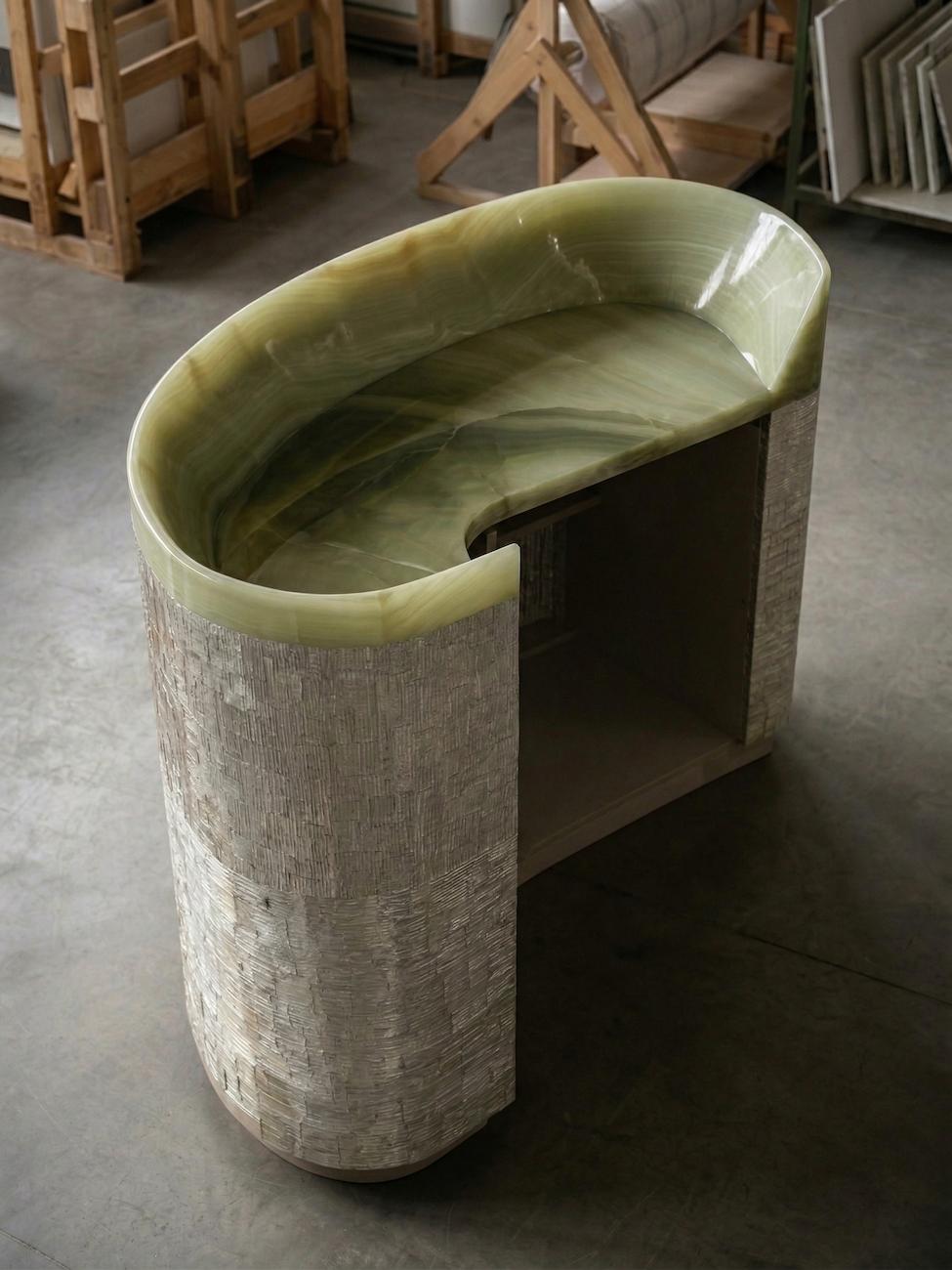
A counter with top and sides carved from a single solid element, with a continuous surface and no visual interruption, is not the kind of object that can be improvised. Every construction detail has to be resolved before production starts, because after that point the margin for correction becomes extremely narrow.
Thicknesses, load distribution, structurally sensitive points, the order of operations, the way the piece would be supported and moved through each stage: everything had to be planned in advance. In an object that aims for clarity and restraint, the technical side has to disappear in the finished result. That is precisely why it has to be resolved so thoroughly.
”The most delicate part was understanding where and how the material might give way during the hollowing-out process,” Misceo explains. ”Onyx can respond unpredictably to stress. We studied every step in order to reduce that risk as much as possible, and developed specific solutions for handling the piece during fabrication as well.”
The most delicate stage: hollowing out the solid block
Hollowing out the solid block was the point at which all that preparatory work was truly tested. CNC machines made it possible to achieve extremely high precision and execute complex paths, but on their own they were not enough. A material like onyx demands constant attention, close observation and the ability to respondwhenever its internal behaviour begins to shift.
Carving into a solid block means redistributing stress at every stage. The walls become thinner, the centre is hollowed out, the weight moves. The material responds differently with each pass of the tool. In a layered stone like onyx, even a minor variation can trigger an unexpected reaction. The risk of breakage does not apply only to the cutting itself, but also to intermediate handling, vibration, and support points that change along with the shape of the piece.
Managing this stage means building a system of control. It is not enough to know how to work the stone; you also need to know how to guide it as it changes: how the material reacts, what signals it gives during fabrication, and how each step needs to be adapted to the specific characteristics of that particular block.
That was the real challenge: creating a volume that would convey solidity, continuity and ease, even though it was the outcome of an extraordinarily delicate process, controlled at every stage.
Finishing, assembly, shipping
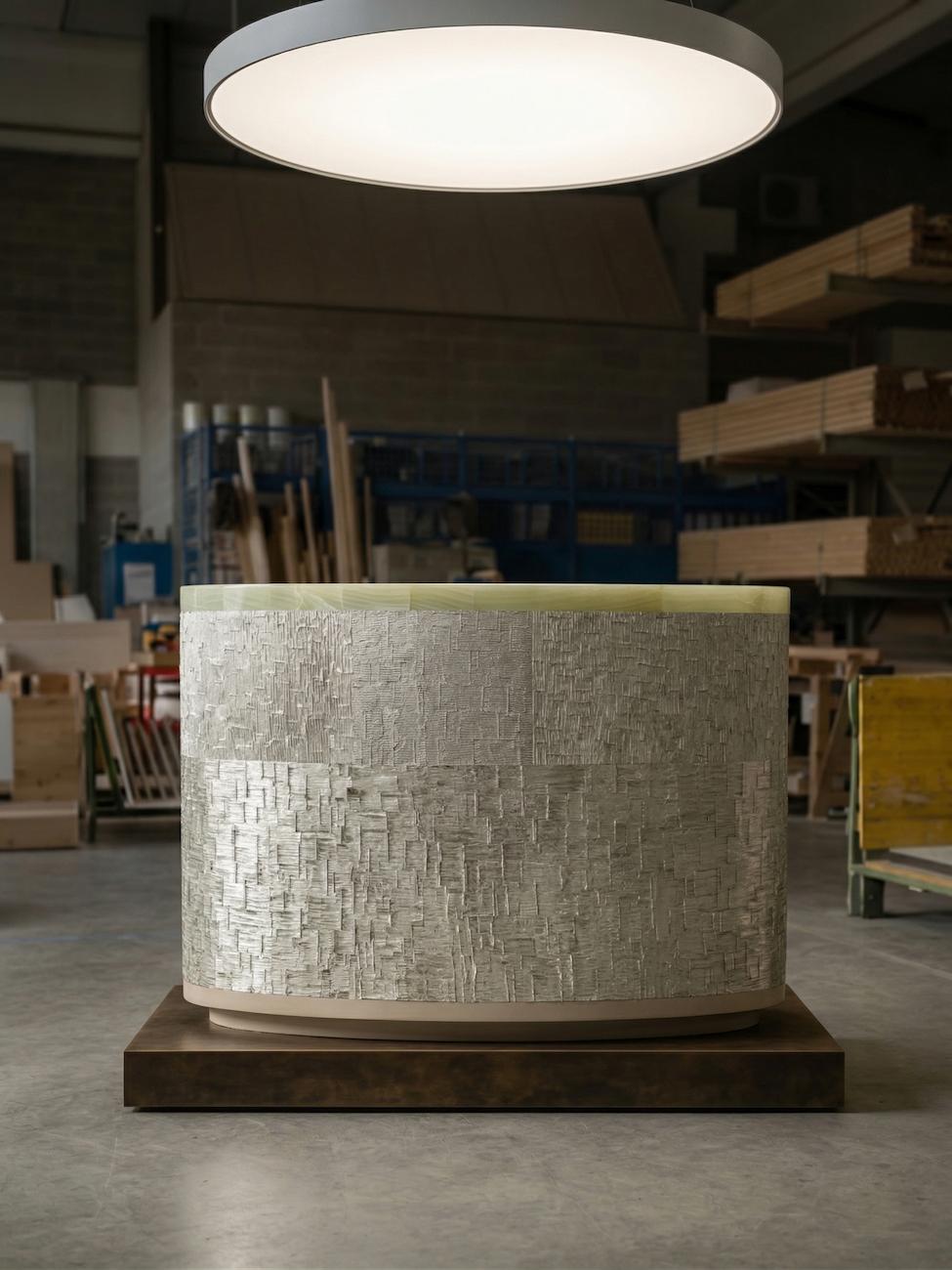
Once the structural work was complete, the counter moved into the finishing stage. It was polished and refined with great care to bring out the distinctive translucency of Green Onyx, a material capable of revealing different degrees of chromatic depth depending on the light.
The piece was then assembled onto its base structure — reinforced to support the weight of the element and ensure stability and safety in use — and underwent a final quality check before packing.
Shipping it to the United States required the development of a custom crating system, designed specifically for that piece and that route. Its size, concentrated weight and the inherent fragility of the material left no room for improvisation. It was detailed work, invisible in the final result, but essential to making sure the counter arrived intact.
This too was part of the project, every bit as much as selecting the block or carving it out. The quality of the work is measured not only in how something is made, but also in how well it is protected and carried through to its destination exactly as intended.
The value of a successful project
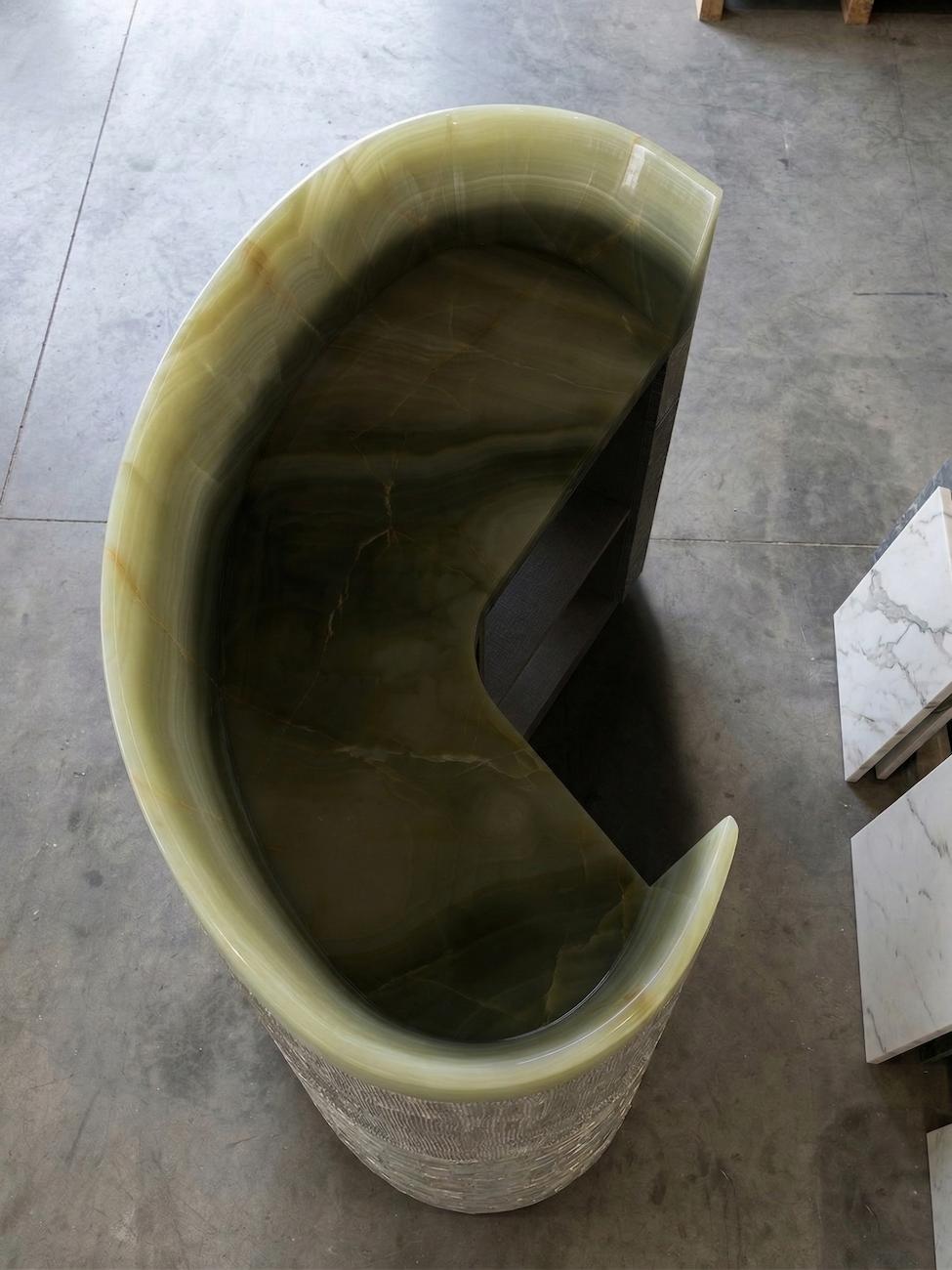
The Green Onyx counter is now part of one of the most anticipated flagship openings of recent years on Rodeo Drive, in the heart of Beverly Hills. Looking at it, what comes across most clearly is the naturalness of the final result. And that is exactly as it should be. It means all the work that came before found its balance, and that none of the difficulties encountered along the way left any visible trace on the final form.
”The client’s compliments were not only about the quality of the piece,” Misceo concludes. ”They were also about our ability to turn a stalled situation into a successful project. For us, it confirmed that when you have the right skills, taking on the most complex challenges is always the most interesting choice.”
Behind an object that appears simple, there was a difficult selection process, invisible design work, fabrication controlled at every step, and logistics with no margin for error.
None of this is visible. But it is exactly what gives the project its meaning.